
Moon near Venus
Tuesday, May 19, 2026
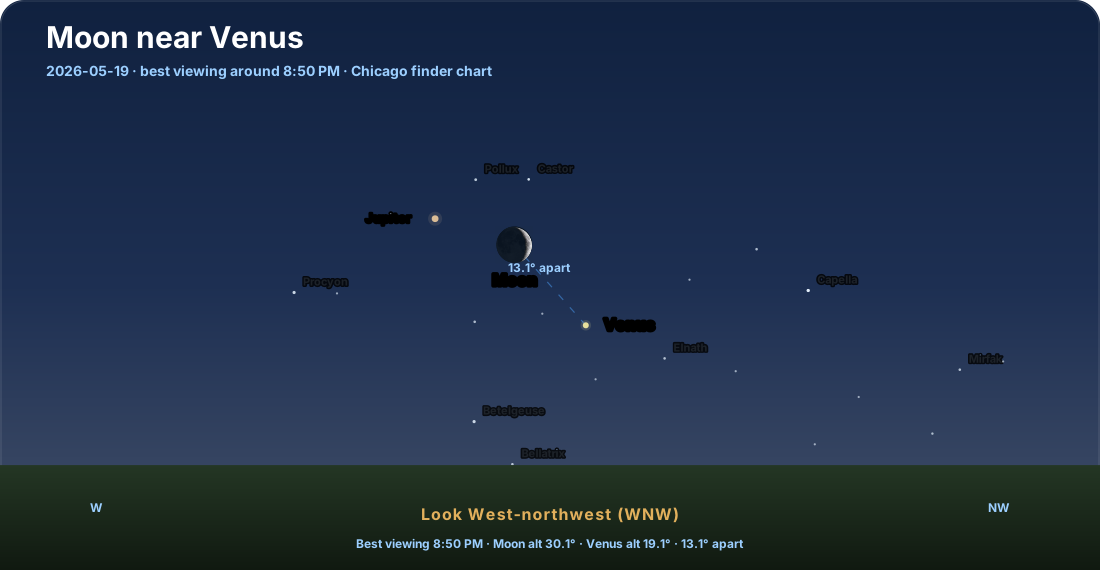
A Moon-planet conjunction occurs when the Moon and a planet appear close together in the sky from Earth’s point of view. The objects are not physically close together in space. The Moon is nearby in astronomical terms, while the planet may be millions or even hundreds of millions of miles farther away. The pairing happens because the Moon and planets all move near the ecliptic, the path followed by the Sun across the sky. These events are among the easiest astronomy sights to identify because the Moon acts as a bright signpost pointing toward the planet.
What Is a Moon-Planet Conjunction?
A Moon-planet conjunction occurs when the Moon and a planet appear close together in the sky from Earth’s point of view.
The objects are not physically close together in space. The Moon is nearby in astronomical terms, while the planet may be millions or even hundreds of millions of miles farther away.
The pairing happens because the Moon and planets all move near the ecliptic, the path followed by the Sun across the sky.
These events are among the easiest astronomy sights to identify because the Moon acts as a bright signpost pointing toward the planet.
Why Moon-Planet Pairings Matter
Moon-planet conjunctions are excellent beginner observing events because they are bright, obvious, and often visible from cities and suburbs.
They help observers learn to identify planets without needing a detailed star chart.
Watching the Moon move past planets over several nights also shows how quickly the Moon changes position against the background sky.
For photographers, these pairings can create dramatic wide-field scenes when framed with a landscape foreground.
What You Might See
The Moon will appear as the dominant object in the scene, with the planet nearby as a bright star-like point.
Venus is usually brilliant white, Jupiter appears bright and steady, Mars can show a warm orange color, and Saturn often has a softer golden tone.
Through a telescope, the Moon and planet may not fit in the same field of view, but each can be observed separately in detail.
How To Observe a Moon-Planet Conjunction
Start by finding the Moon, then look nearby for the planet listed for the event.
If the planet is bright, it may be obvious to the naked eye. Venus and Jupiter are especially easy, while Mars and Saturn may be more subtle.
If the planet is faint or the sky is bright with twilight, binoculars can help locate it more easily.
The exact view depends on your location, local horizon, weather, and the time you observe.
How to plan your observation
- Find the Moon first and scan the nearby sky for the planet.
- Check whether the event is best seen before sunrise or after sunset.
- Use binoculars if the planet is faint, low, or near twilight.
- Observe on the nights before and after the event to watch the Moon’s motion.
- Try a wide-angle photo that includes the Moon, planet, and foreground landscape.
The Science Behind the Pairing
The Moon orbits Earth once every month, moving eastward against the background stars from night to night.
The planets also appear near the ecliptic because their orbits lie close to the same plane as Earth’s orbit.
When the Moon passes near one of these planets from our viewpoint, we see a conjunction.
This is a line-of-sight alignment, not a true close approach in space.
Fun Fact
The Moon moves roughly its own apparent diameter across the sky every hour.
That motion is slow enough to watch over a night, but fast enough that the Moon’s position near a planet noticeably changes from one evening to the next.
What to remember
The Moon may be bright enough to reduce contrast, especially when it is near a faint planet.
A close-looking pairing in the sky does not mean the Moon and planet are physically close together.
The best view may occur before or after the listed calendar date depending on your location and local timing.
Common Questions About Moon near Venus
When does Moon near Venus occur?
Moon near Venus is listed for May 19, 2026.
Can I observe this event from my location?
Visibility depends on your location, local horizon, weather, and timing. Use Ephemeris with your saved observing location to check conditions.
What equipment should I use?
Naked eye or binoculars
