
Moon near Pollux
Thursday, April 23, 2026
A Moon-star conjunction occurs when the Moon appears close to a star from Earth’s point of view. The Moon is only about a quarter-million miles away, while the star is many light-years away. The apparent pairing is caused by line-of-sight geometry as the Moon moves across the sky. These events are useful because the Moon can help you identify bright stars and their constellations.
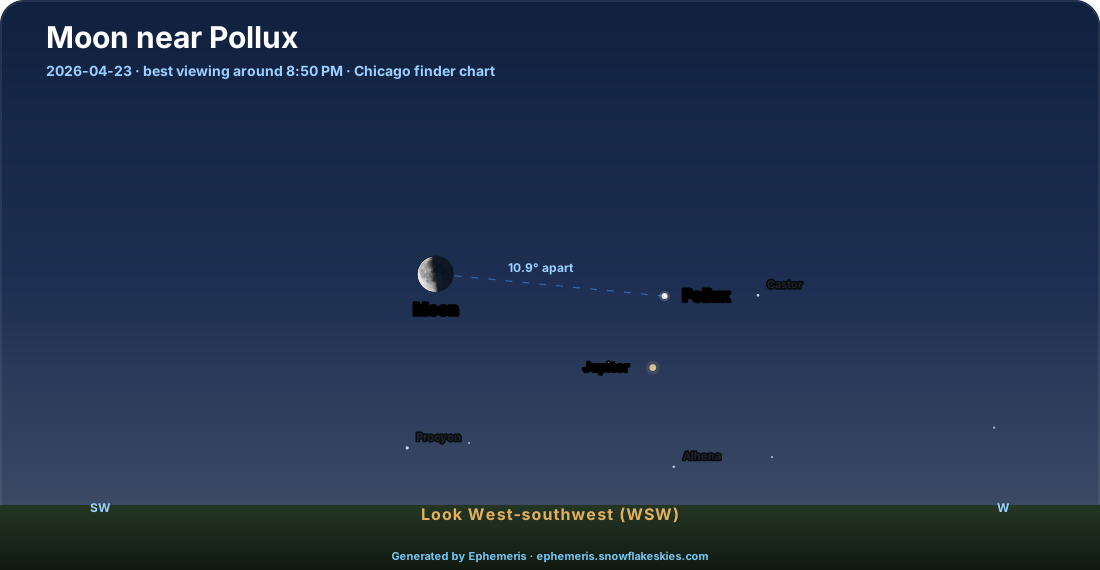
What Is a Moon-Star Conjunction?
A Moon-star conjunction occurs when the Moon appears close to a star from Earth’s point of view.
The Moon is only about a quarter-million miles away, while the star is many light-years away.
The apparent pairing is caused by line-of-sight geometry as the Moon moves across the sky.
These events are useful because the Moon can help you identify bright stars and their constellations.
Why Moon-Star Pairings Matter
Moon-star conjunctions are simple but powerful learning events.
They help observers connect the Moon’s monthly motion with the fixed background of stars.
When the star is bright, the event can be visible even under moderate light pollution.
Repeated observations show how the Moon shifts eastward through the constellations night after night.
What You Might See
The Moon will appear as the bright anchor of the scene, with the star nearby as a point of light.
Bright stars may remain visible despite moonlight, while fainter stars may be washed out.
If the Moon is close to the star, the contrast between the Moon’s nearby brightness and the distant star can be striking.
How To Observe a Moon-Star Conjunction
Find the Moon first, then look nearby for the star named in the event.
The star may be easy to see if the Moon is a thin crescent, but more difficult when the Moon is bright or nearly full.
Binoculars can help when glare from the Moon makes the star harder to detect.
If the Moon is extremely close to the star, check whether the event may become an occultation from your location.
How to plan your observation
- Use the Moon as your starting point.
- Shield your eyes from direct Moon glare if the star is faint.
- Use binoculars for dimmer stars or bright Moon phases.
- Check a star chart to identify the surrounding constellation.
- Observe on adjacent nights to see the Moon’s motion against the stars.
The Science Behind the View
The Moon moves eastward across the sky by about 13 degrees per day relative to the background stars.
That motion carries it through the zodiac constellations and near many bright stars each month.
A conjunction is an apparent alignment from Earth, not a physical encounter.
The star remains far beyond the Solar System while the Moon passes through our foreground view.
Fun Fact
Because the Moon moves so quickly against the background stars, it can be used as a natural pointer for learning the sky.
A star that seems hard to find on one night may become obvious when the Moon passes nearby.
What to remember
Moonlight can make nearby stars harder to see, especially when the Moon is gibbous or full.
Some conjunctions are more educational than visually dramatic.
The exact separation and visibility can vary depending on your location and observing time.
Common Questions About Moon near Pollux
When does Moon near Pollux occur?
Moon near Pollux is listed for April 23, 2026.
Can I observe this event from my location?
Visibility depends on your location, local horizon, weather, and timing. Use Ephemeris with your saved observing location to check conditions.
What equipment should I use?
Naked eye or binoculars
