
Leonid Meteor Shower Peak
Wednesday, November 18, 2026
A meteor shower occurs when Earth passes through a stream of dust and small debris left behind by a comet or, in some cases, an asteroid. As these particles strike Earth’s atmosphere at tremendous speeds, friction heats the surrounding air and causes the particles to vaporize, creating bright streaks of light called meteors. Most meteor-shower particles are no larger than grains of sand, yet they can produce spectacular flashes visible from many miles away. Meteor showers appear to radiate from a particular constellation because of perspective, similar to railroad tracks appearing to converge in the distance.
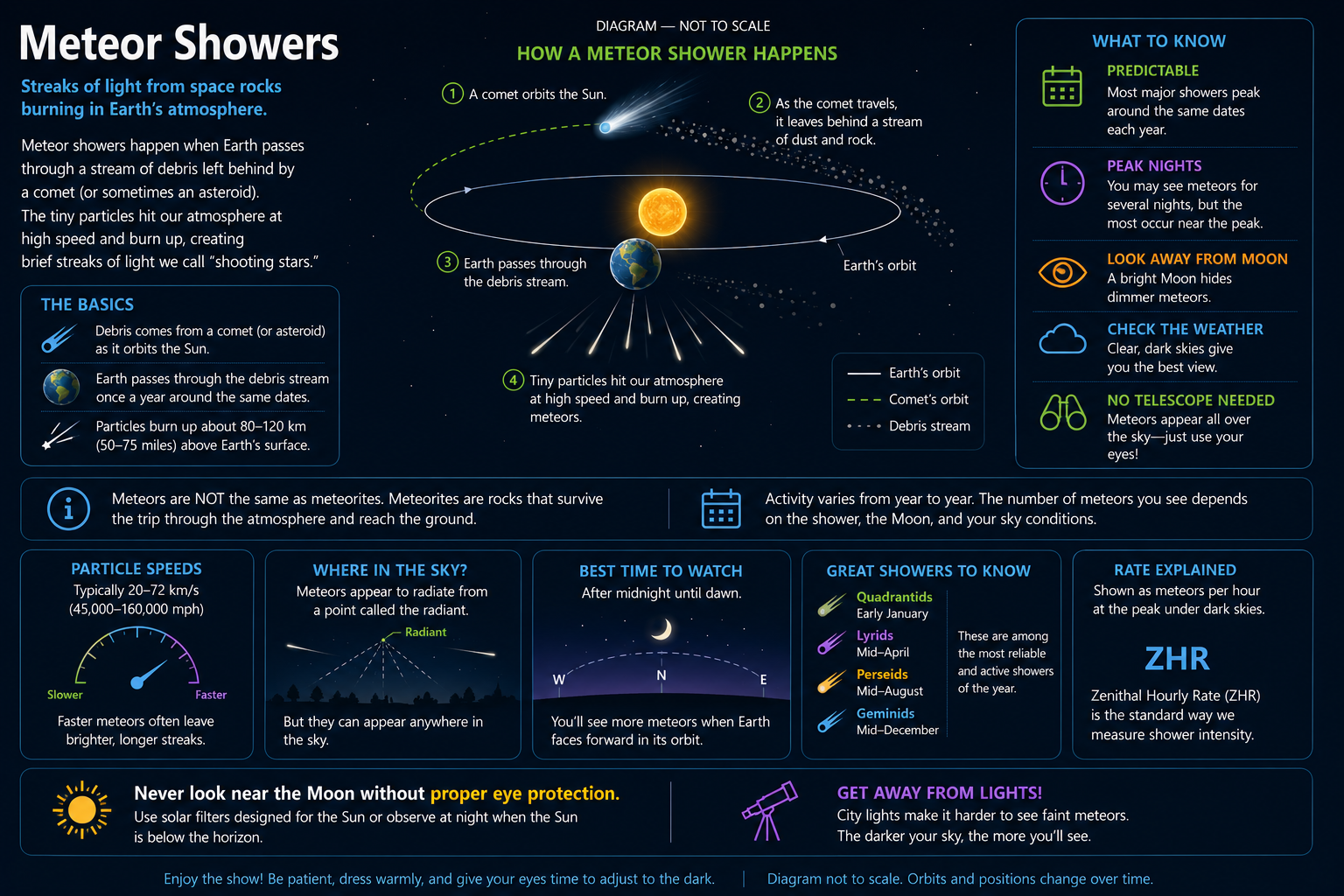
What Is a Meteor Shower?
A meteor shower occurs when Earth passes through a stream of dust and small debris left behind by a comet or, in some cases, an asteroid.
As these particles strike Earth’s atmosphere at tremendous speeds, friction heats the surrounding air and causes the particles to vaporize, creating bright streaks of light called meteors.
Most meteor-shower particles are no larger than grains of sand, yet they can produce spectacular flashes visible from many miles away.
Meteor showers appear to radiate from a particular constellation because of perspective, similar to railroad tracks appearing to converge in the distance.
Why Meteor Shower Peaks Matter
Meteor showers are active for days or weeks, but activity typically reaches a maximum during a short peak period.
The peak occurs when Earth passes through the densest portion of the debris stream.
During favorable years, observers may see dozens of meteors per hour, while major showers such as the Perseids or Geminids can occasionally produce over 100 meteors per hour under ideal dark-sky conditions.
Moonlight, cloud cover, and local light pollution can significantly reduce the number of meteors visible to the naked eye.
What You Might See
Most meteors appear as brief flashes lasting less than a second.
Some leave glowing trails that persist for several seconds after the meteor itself disappears.
Occasionally, exceptionally bright meteors called fireballs can rival Venus in brightness and illuminate the surrounding landscape.
During strong showers, observers may see multiple meteors within a few minutes, while weaker showers can require patience between sightings.
How To Watch a Meteor Shower
Meteor showers require no telescope and no special equipment.
The best strategy is simply to get comfortable, allow your eyes to adjust to the darkness, and watch as much sky as possible.
While meteors appear to radiate from a specific constellation, the brightest meteors can appear anywhere overhead.
Patience is important. Meteors often arrive in bursts, followed by quieter periods.
How to plan your observation
- Find the darkest location you can reasonably reach.
- Avoid streetlights, vehicle headlights, and bright phone screens.
- Allow at least 20–30 minutes for full dark adaptation.
- Use a reclining chair or blanket to comfortably view a large portion of the sky.
- Look roughly halfway between the horizon and overhead rather than directly at the radiant.
- Dress warmer than you think you need—meteor observing often involves long periods of sitting still.
- Plan your observing session around moon phase and local weather forecasts.
The Science Behind Meteor Showers
Meteor showers provide direct evidence of how material is distributed throughout the Solar System.
Most showers originate from debris released by comets as sunlight heats their icy surfaces during repeated trips around the Sun.
Over time, these particles spread along the comet’s orbit, forming a debris stream that Earth intersects each year.
By studying meteor speeds, trajectories, and compositions, astronomers learn more about the parent comet and the history of the Solar System.
Fun Fact
Every meteor you see is traveling faster than a rifle bullet.
Many meteor-shower particles enter Earth’s atmosphere at speeds between 20 and 70 kilometers per second (45,000–160,000 mph).
Despite these incredible speeds, most particles are completely destroyed long before reaching the ground.
What to remember
Photographs of meteor showers often combine many meteors captured over several hours.
The sky rarely looks as crowded as promotional images suggest.
A successful meteor-shower session usually involves patience, dark skies, and realistic expectations rather than constant activity.
Even major showers can be disappointing if bright moonlight or poor weather interferes.
Common Questions About Leonid Meteor Shower Peak
When does Leonid Meteor Shower Peak occur?
Leonid Meteor Shower Peak is listed for November 18, 2026.
Can I observe this event from my location?
Visibility depends on your location, local horizon, weather, and timing. Use Ephemeris with your saved observing location to check conditions.
What equipment should I use?
Naked eye
