
Lunar occultation of Antares
Wednesday, October 14, 2026
An occultation occurs when one astronomical object moves directly in front of another and blocks it from view. The most common occultations involve the Moon passing in front of a star, planet, or bright deep-sky object. Unlike a conjunction, where two objects merely appear close together in the sky, an occultation involves one object actually covering the other from the observer’s perspective. These events can be surprisingly dramatic because the hidden object often disappears or reappears almost instantly.
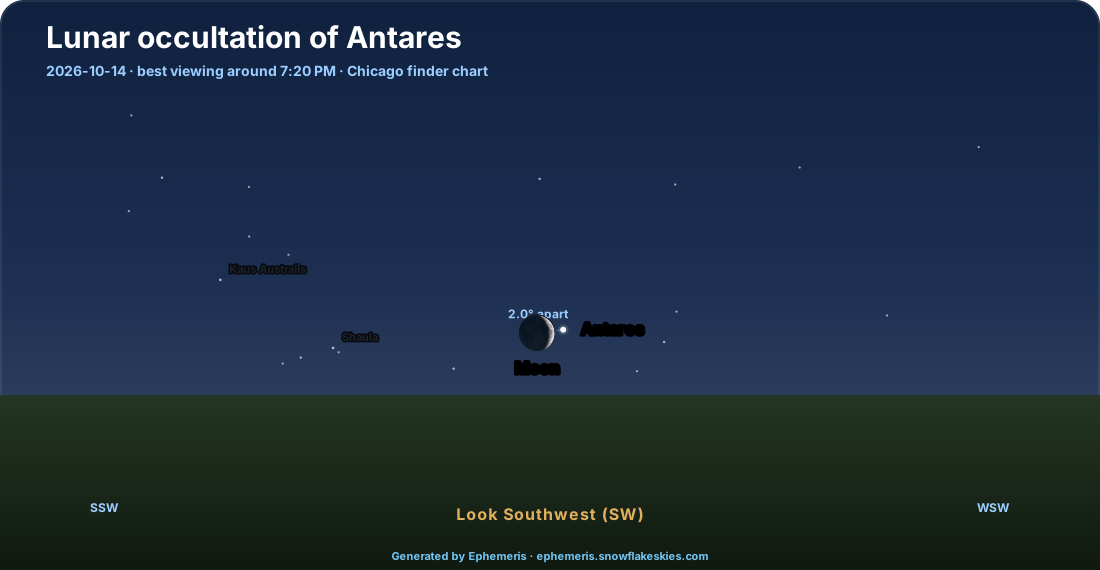
What Is an Occultation?
An occultation occurs when one astronomical object moves directly in front of another and blocks it from view.
The most common occultations involve the Moon passing in front of a star, planet, or bright deep-sky object.
Unlike a conjunction, where two objects merely appear close together in the sky, an occultation involves one object actually covering the other from the observer’s perspective.
These events can be surprisingly dramatic because the hidden object often disappears or reappears almost instantly.
Why Occultations Matter
Occultations provide a unique opportunity to watch celestial motion in real time.
Observers can often see a star or planet suddenly vanish behind the Moon’s edge and then reappear minutes later.
Historically, occultations helped astronomers refine orbital calculations and improve measurements of the Moon’s motion.
Modern observations are still scientifically valuable for studying lunar topography, asteroid shapes, and stellar positions.
What You Might See
A bright star may appear to switch off instantly as it passes behind the Moon.
Planets can take slightly longer to disappear because they have visible disks rather than appearing as point sources.
The reappearance can be just as dramatic, with the object suddenly emerging from the Moon’s dark limb.
Under steady conditions, these events can feel surprisingly dynamic compared with most astronomical observations.
How To Observe an Occultation
Timing is critical because occultations are often brief and location dependent.
Check local visibility information before observing, as not every occultation is visible from every location on Earth.
The disappearance and reappearance points may occur on different sides of the Moon.
Binoculars can be sufficient for bright-star occultations, while telescopes provide the most impressive views.
How to plan your observation
- Verify that the occultation is visible from your location.
- Arrive and set up equipment at least 15–30 minutes before the event.
- Focus carefully before the occultation begins.
- Watch continuously near the predicted disappearance time.
- If possible, record the event with a camera or video setup.
- Pay attention to both the disappearance and reappearance portions of the event.
The Science Behind Occultations
Occultations occur because objects in the Solar System constantly move relative to one another.
The Moon is responsible for most visible occultations because it moves across the sky quickly compared with stars and planets.
Precise occultation timing has been used to map lunar mountains, refine asteroid orbits, and even discover rings around distant minor planets.
Before spacecraft exploration, occultation observations provided some of the best measurements of lunar surface features.
Fun Fact
The Moon moves its own apparent diameter across the sky in roughly one hour.
That motion is fast enough that observers can sometimes watch an occultation unfold in real time without needing time-lapse photography.
What to remember
Not every occultation is dramatic to the naked eye.
Many require binoculars or a telescope, especially when faint stars are involved.
Weather, timing accuracy, and observer location can determine whether an occultation is visible at all.
Common Questions About Lunar occultation of Antares
When does Lunar occultation of Antares occur?
Lunar occultation of Antares is listed for October 14, 2026.
Can I observe this event from my location?
Visibility depends on your location, local horizon, weather, and timing. Use Ephemeris with your saved observing location to check conditions.
What equipment should I use?
Binoculars or telescope
