
Moon near the Pleiades
Monday, March 23, 2026
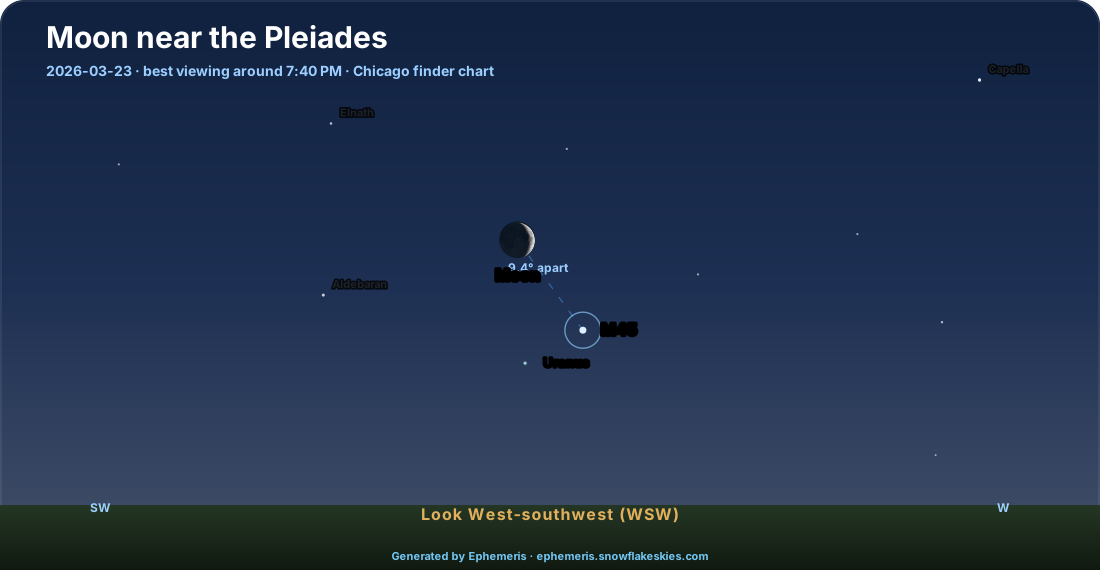
A Moon-deep sky conjunction occurs when the Moon appears near a star cluster, nebula, or galaxy from Earth’s point of view. The Moon is close to Earth, while the deep-sky object may be hundreds, thousands, or millions of light-years away. The objects only appear near one another because they lie along a similar line of sight in the sky. These pairings can help observers learn where famous deep-sky objects are located, even if the Moon’s brightness makes them harder to see.
What Is a Moon-Deep Sky Pairing?
A Moon-deep sky conjunction occurs when the Moon appears near a star cluster, nebula, or galaxy from Earth’s point of view.
The Moon is close to Earth, while the deep-sky object may be hundreds, thousands, or millions of light-years away.
The objects only appear near one another because they lie along a similar line of sight in the sky.
These pairings can help observers learn where famous deep-sky objects are located, even if the Moon’s brightness makes them harder to see.
Why This Event Matters
The Moon can act as a bright signpost pointing toward a deep-sky object.
That makes the event useful for learning the sky, especially for bright clusters such as the Pleiades or Beehive Cluster.
However, moonlight can wash out faint nebulosity, galaxies, and dim cluster members.
For true deep-sky observing, the best view often comes on a nearby moonless night after using this event to learn the object’s location.
What You Might See
Bright clusters may appear as small groupings of stars near the Moon.
Large open clusters can be beautiful in binoculars even when the sky is not perfectly dark.
Nebulae and galaxies are usually more affected by moonlight and may appear faint, washed out, or invisible.
The Moon itself may dominate the scene, so the event is often more useful as a finder opportunity than a best-viewing window.
How To Observe It
Find the Moon first, then use the chart to identify the nearby deep-sky object.
If the object is a bright open cluster, binoculars may show it even with the Moon nearby.
If the object is a galaxy or nebula, moonlight may make the view difficult or nearly impossible from light-polluted skies.
Consider this event both an observing opportunity and a sky-learning marker.
How to plan your observation
- Use binoculars for large open clusters near the Moon.
- Shield your eyes from direct moonlight when looking for faint objects.
- Try again on a darker night if the object is washed out.
- Use this event to learn the object’s location relative to nearby stars.
- For imaging, expect moonlight to reduce contrast unless the target is bright.
The Science Behind the Pairing
The Moon moves through the sky quickly as it orbits Earth, passing near many background objects each month.
Deep-sky objects are far beyond the Moon and do not move noticeably from night to night.
When the Moon passes near one of them from our perspective, it creates a temporary visual pairing.
The event highlights the huge difference in distance between nearby Solar System objects and the deep universe beyond.
Fun Fact
Some of the most famous Moon-deep sky pairings involve the Pleiades and Beehive Cluster.
Both are bright open clusters that can fit nicely in binocular fields when the Moon is not too overpowering.
What to remember
The Moon is often the enemy of faint deep-sky observing.
If the nearby object looks disappointing during the conjunction, that does not mean the object itself is unimpressive.
Return during a darker Moon phase for a much better deep-sky view.
Common Questions About Moon near the Pleiades
When does Moon near the Pleiades occur?
Moon near the Pleiades is listed for March 23, 2026.
Can I observe this event from my location?
Visibility depends on your location, local horizon, weather, and timing. Use Ephemeris with your saved observing location to check conditions.
What equipment should I use?
Binoculars or telescope
