
Mercury at Perihelion
Friday, June 21, 2030
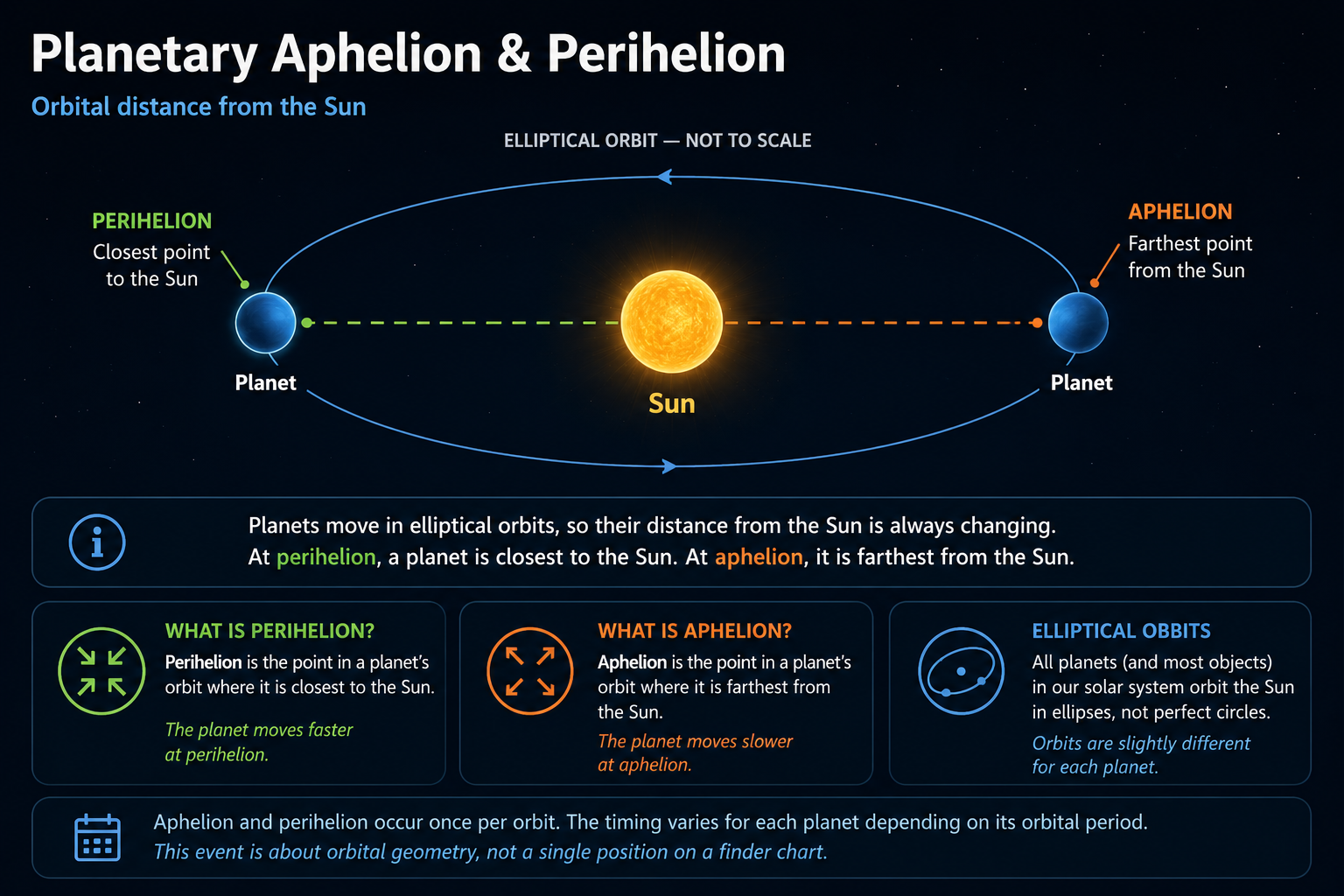
A planetary orbital event marks a specific point or condition in a planet’s path around the Sun. Examples can include perihelion, aphelion, nodes, conjunction-related geometry, or other orbital milestones. These events are not always visually dramatic, but they help explain how planetary visibility changes over time.
What Is a Planetary Orbital Event?
A planetary orbital event marks a specific point or condition in a planet’s path around the Sun.
Examples can include perihelion, aphelion, nodes, conjunction-related geometry, or other orbital milestones.
These events are not always visually dramatic, but they help explain how planetary visibility changes over time.
Why Orbital Events Matter
Planetary observing is shaped by orbital geometry.
A planet’s distance from the Sun, distance from Earth, angle from the Sun, and position relative to the ecliptic all affect how and when it can be seen.
Orbital events provide context for why a planet may be bright, faint, high, low, visible, or hidden in solar glare.
What You Might See
The visual result depends on the specific orbital event and planet involved.
Some orbital events correspond to improved visibility, while others occur when the planet is difficult or impossible to observe.
The most useful takeaway is often understanding how the planet’s position is changing in its orbit.
How To Use This Event
Treat this event as a planning and learning marker rather than assuming it will produce a dramatic view.
Check whether the planet is currently visible from your location and whether it is best placed before sunrise, after sunset, or during the night.
Use the event to understand where the planet is in its current observing season.
How to plan your observation
- Check the planet’s altitude and direction for your location.
- Confirm whether it is visible before sunrise, after sunset, or overnight.
- Use a planetarium app or sky chart to identify its position.
- Compare this event with nearby conjunction, opposition, elongation, or brightness dates.
The Science Behind Planetary Orbits
Planets follow elliptical orbits around the Sun rather than perfect circles.
Their apparent positions from Earth change because both Earth and the other planets are moving at different speeds and distances.
Orbital events are predictable milestones that help astronomers describe this motion precisely.
Fun Fact
The same orbital mechanics that determine planetary events also guide spacecraft trajectories, satellite motion, and comet returns.
Calendar events are visible reminders that the Solar System is constantly in motion.
What to remember
Not every orbital event is a visual spectacle.
Some are primarily useful for understanding timing, geometry, and future observing opportunities.
Common Questions About Mercury at Perihelion
When does Mercury at Perihelion occur?
Mercury at Perihelion is listed for June 21, 2030.
Can I observe this event from my location?
Visibility depends on your location, local horizon, weather, and timing. Use Ephemeris with your saved observing location to check conditions.
What equipment should I use?
Depends on the planet and event geometry
