
New Moon
Monday, June 15, 2026
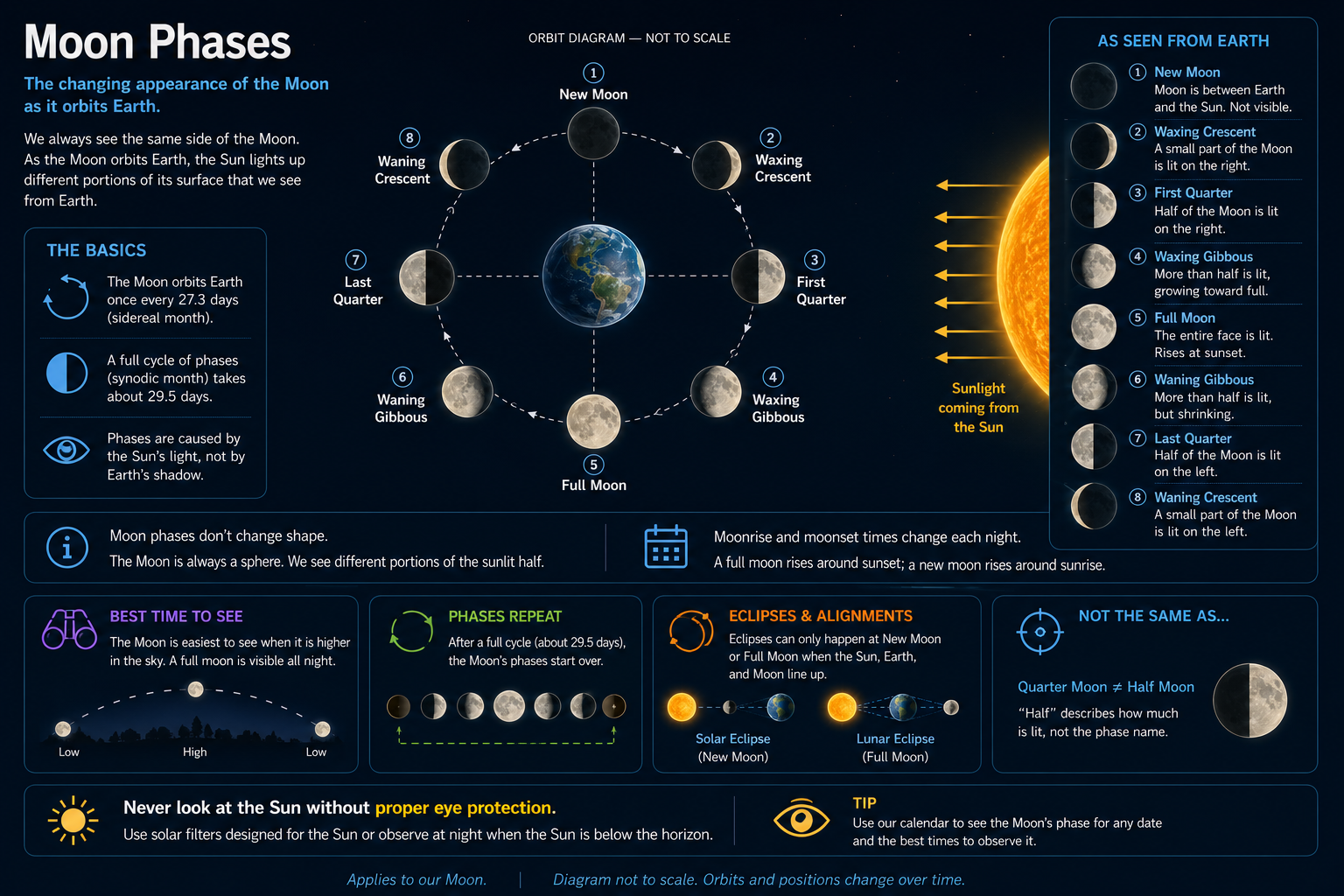
A New Moon occurs when the Moon is positioned between Earth and the Sun. During this phase, the Moon’s illuminated side faces mostly away from Earth, making the Moon difficult or impossible to see in the night sky. New Moon marks the beginning of a new lunar cycle and creates the darkest skies of the month.
What Is a New Moon?
A New Moon occurs when the Moon is positioned between Earth and the Sun.
During this phase, the Moon’s illuminated side faces mostly away from Earth, making the Moon difficult or impossible to see in the night sky.
New Moon marks the beginning of a new lunar cycle and creates the darkest skies of the month.
Why New Moon Matters
New Moon is one of the most important planning dates for deep-sky observing and astrophotography.
Without bright moonlight, faint galaxies, nebulae, star clusters, and the Milky Way are much easier to see.
Dark-sky trips, star parties, and imaging sessions are often planned around the New Moon window.
What You Might See
You usually will not see the Moon at the exact New Moon phase.
The real reward is a darker night sky with improved contrast for faint objects.
A thin crescent Moon may become visible shortly after New Moon, low in the western sky after sunset.
How To Use the New Moon
The New Moon itself is usually not something to observe directly because it is too close to the Sun in the sky.
Instead, observers use the nights around New Moon as prime dark-sky opportunities.
This is the best time of the lunar month to observe faint deep-sky targets if weather and transparency cooperate.
How to plan your observation
- Plan deep-sky observing or imaging around the New Moon window.
- Choose a dark location away from city lights.
- Check transparency, cloud cover, humidity, and smoke conditions.
- Target galaxies, nebulae, star clusters, and Milky Way regions.
- Look for the young crescent Moon one or two evenings after New Moon.
The Science Behind New Moon
At New Moon, the Moon lies roughly in the same direction as the Sun from Earth’s perspective.
Because the Moon’s orbit is tilted, it usually passes above or below the Sun rather than directly in front of it.
When the alignment is exact, a solar eclipse can occur.
Fun Fact
A very young crescent Moon can sometimes be seen less than two days after New Moon.
Spotting it requires a clear western horizon, good transparency, and careful timing after sunset.
What to remember
New Moon does not guarantee good observing conditions.
Clouds, haze, smoke, humidity, and light pollution can still ruin a dark-sky night.
Common Questions About New Moon
When does New Moon occur?
New Moon is listed for June 15, 2026.
Can I observe this event from my location?
Visibility depends on your location, local horizon, weather, and timing. Use Ephemeris with your saved observing location to check conditions.
What equipment should I use?
Naked eye, binoculars, telescope, or camera
