
Moon at Perigee
Thursday, February 1, 2029
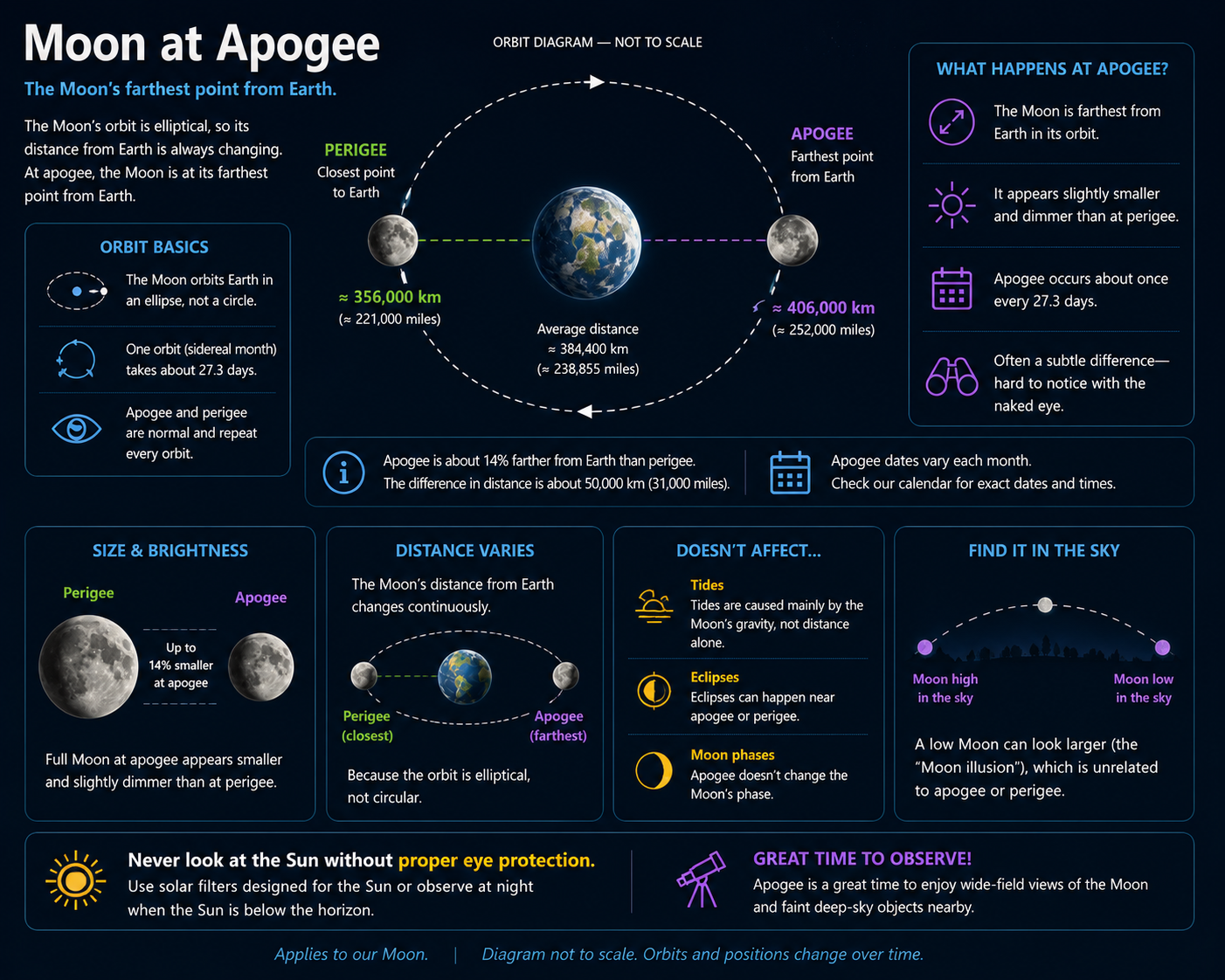
The Moon does not orbit Earth in a perfect circle. It follows a slightly elliptical path. Because of this elliptical orbit, the Moon’s distance from Earth changes continuously throughout each month. Perigee is the point where the Moon is closest to Earth. Every lunar month includes one apogee and one perigee as the Moon travels around our planet.
What Is Moon Perigee?
The Moon does not orbit Earth in a perfect circle. It follows a slightly elliptical path.
Because of this elliptical orbit, the Moon’s distance from Earth changes continuously throughout each month.
Perigee is the point where the Moon is closest to Earth.
Every lunar month includes one apogee and one perigee as the Moon travels around our planet.
Why This Event Matters
The changing distance between Earth and the Moon explains why the Moon does not always appear exactly the same size in the sky.
Near perigee, the Moon appears slightly larger and brighter than average.
These distance changes are also responsible for the difference between so-called “supermoons” and “micromoons.”
This event is a simple, visible example of orbital mechanics.
What You Might Notice
Most people will not notice the size difference with casual viewing alone.
The apparent diameter difference between apogee and perigee is roughly 12–14 percent.
At perigee, the Moon appears slightly larger than average.
Side-by-side photographs make the effect much easier to see.
How To Observe It
The event itself does not create a dramatic visual change from one night to the next.
The best way to appreciate the effect is by comparing photographs taken near both apogee and perigee using identical camera settings.
The Moon can be observed from cities, suburbs, or dark-sky sites.
The effect is most noticeable when apogee or perigee occurs near a Full Moon.
How to plan your observation
- Photograph the Moon at both apogee and perigee for comparison.
- Use the same focal length and camera settings for both images.
- Observe the Moon when it is reasonably high above the horizon.
- Compare apparent diameter rather than brightness alone.
- Use this event to learn how elliptical orbits work.
The Science Behind It
The Moon’s average distance from Earth is about 238,855 miles, or 384,400 kilometers.
At apogee and perigee, that distance can vary by more than 30,000 miles, or about 50,000 kilometers.
These changes happen because gravity creates elliptical orbits rather than perfect circles.
The Moon’s orbit is one of the easiest ways to see orbital mechanics in action.
Fun Fact
A Full Moon occurring near perigee is commonly called a Supermoon.
Neither term is an official astronomical designation, but both are widely used by the public.
What to remember
The Moon’s size change is real, but it is subtle.
Many comparison images exaggerate the effect.
The difference is easiest to see in photos taken with the same lens and settings.
Common Questions About Moon at Perigee
When does Moon at Perigee occur?
Moon at Perigee is listed for February 1, 2029.
Can I observe this event from my location?
Visibility depends on your location, local horizon, weather, and timing. Use Ephemeris with your saved observing location to check conditions.
What equipment should I use?
Naked eye, binoculars, telescope, or camera
