
Mercury and Mars Conjunction
Wednesday, April 17, 2030
A planetary conjunction occurs when two planets, or a planet and another bright celestial object, appear close together in the sky from Earth’s perspective. The objects are not actually close together in space. In many cases they remain separated by hundreds of millions of miles. A conjunction is simply a line-of-sight effect created by the orbital motions of Earth and the other objects involved. Some conjunctions are subtle, while others create spectacular pairings that become major public astronomy events.
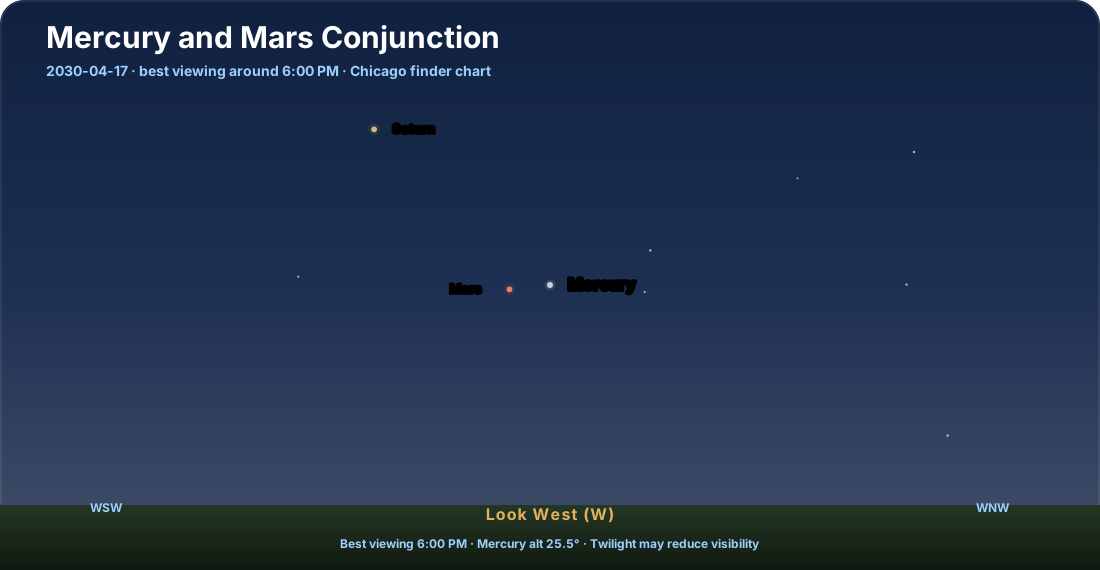
What Is a Planetary Conjunction?
A planetary conjunction occurs when two planets, or a planet and another bright celestial object, appear close together in the sky from Earth’s perspective.
The objects are not actually close together in space. In many cases they remain separated by hundreds of millions of miles.
A conjunction is simply a line-of-sight effect created by the orbital motions of Earth and the other objects involved.
Some conjunctions are subtle, while others create spectacular pairings that become major public astronomy events.
Why Planetary Conjunctions Matter
Conjunctions provide some of the easiest and most rewarding astronomy observing opportunities.
Unlike faint deep-sky objects, bright planets can often be observed from cities, suburbs, and dark-sky locations alike.
These events help observers understand how planets move across the sky relative to one another over time.
They also create beautiful photographic opportunities and often serve as a gateway event for people new to astronomy.
What You Might See
The appearance depends on the objects involved and their angular separation.
Some conjunctions place the objects several degrees apart, while others bring them close enough to fit comfortably within the same binocular field.
Bright planets often display distinct colors. Venus appears brilliant white, Mars may appear orange-red, and Saturn often has a soft golden hue.
During exceptionally close conjunctions, the pairing can become one of the most memorable naked-eye sights of the year.
How To Observe a Planetary Conjunction
Begin by identifying when the conjunction reaches its closest apparent separation.
Many conjunctions occur during twilight, making a clear eastern or western horizon important.
The event is usually visible for several days before and after the closest approach, allowing observers to watch the changing geometry unfold.
Even a small pair of binoculars can significantly enhance the experience by framing both objects together in a single field of view.
How to plan your observation
- Check whether the event occurs before sunrise or after sunset.
- Find an observing location with an unobstructed horizon.
- Arrive early if the objects are low in the sky.
- Observe on several nights to watch the spacing change.
- Use binoculars for the most pleasing wide-field view.
- Try photographing the conjunction against a scenic foreground.
The Science Behind Conjunctions
Conjunctions occur because planets orbit the Sun at different speeds and distances.
As Earth and the other planets move through their orbits, their apparent positions against the background stars continuously change.
Occasionally those changing positions place two objects near one another from our viewpoint, producing a conjunction.
These events are excellent demonstrations of the dynamic nature of the Solar System and the fact that planetary positions are constantly changing.
Fun Fact
Some of the most famous conjunctions in history have been proposed as explanations for the biblical Star of Bethlehem.
While the true nature of that object remains unknown, close conjunctions between bright planets can create remarkably eye-catching displays.
What to remember
A conjunction does not mean the planets are physically near one another.
The effect is entirely due to perspective from Earth.
Even during an extremely close conjunction, the objects may still be separated by hundreds of millions of miles in space.
What makes the event special is how the geometry appears from our vantage point.
Common Questions About Mercury and Mars Conjunction
When does Mercury and Mars Conjunction occur?
Mercury and Mars Conjunction is listed for April 17, 2030.
Can I observe this event from my location?
Visibility depends on your location, local horizon, weather, and timing. Use Ephemeris with your saved observing location to check conditions.
What equipment should I use?
Naked eye or binoculars
