
Mercury at Greatest Evening Elongation
Friday, December 14, 2029
Greatest elongation occurs when an inner planet appears farthest from the Sun in Earth’s sky. This event applies only to Mercury and Venus because their orbits lie inside Earth’s orbit around the Sun. From our perspective, the planet reaches its maximum angular separation from the Sun, placing it farther from the bright solar glare than at any other point in that observing cycle. As a result, greatest elongation often represents one of the best opportunities to observe the planet.
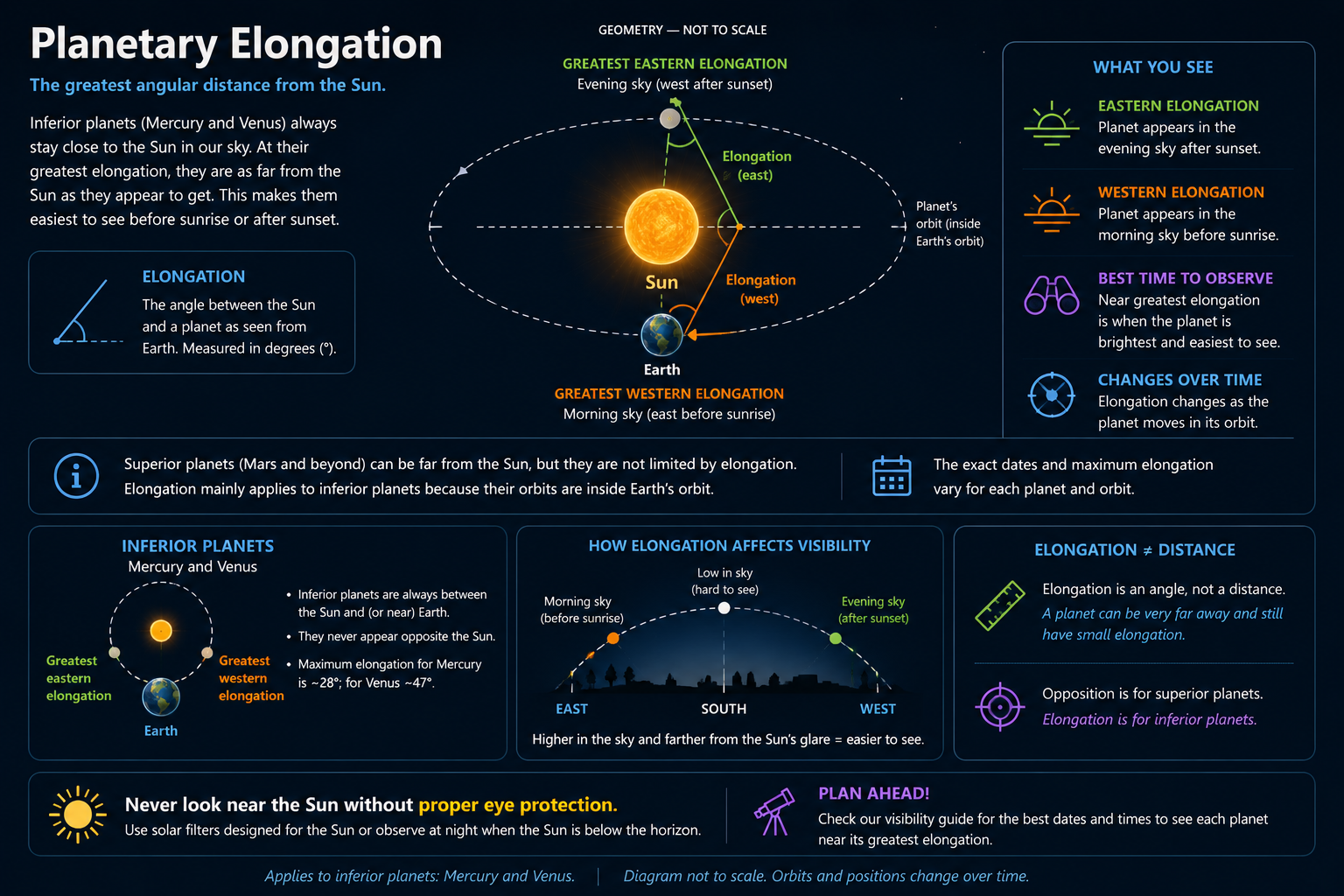
What Is Greatest Elongation?
Greatest elongation occurs when an inner planet appears farthest from the Sun in Earth’s sky.
This event applies only to Mercury and Venus because their orbits lie inside Earth’s orbit around the Sun.
From our perspective, the planet reaches its maximum angular separation from the Sun, placing it farther from the bright solar glare than at any other point in that observing cycle.
As a result, greatest elongation often represents one of the best opportunities to observe the planet.
Why Greatest Elongation Matters
Mercury never strays very far from the Sun in the sky.
Most of the time the planet is hidden in bright twilight or lost completely in daylight.
Greatest elongation provides a predictable observing window when the planet is easiest to locate and remains above the horizon for its longest practical viewing period.
For Mercury especially, greatest elongation often marks the best viewing opportunity of an entire observing season.
What You Might See
Mercury often appears as a bright yellow-white star-like object low in twilight.
Through a telescope, both Mercury and Venus display phases similar to the Moon.
Depending on the elongation, the planet may appear half illuminated, crescent-shaped, or gibbous.
The appearance changes because we observe different portions of the planet’s sunlit hemisphere throughout its orbit.
How To Observe Greatest Elongation
First determine whether the elongation is an eastern elongation or western elongation.
Eastern elongations place the planet in the evening sky after sunset, while western elongations place it in the morning sky before sunrise.
A clear horizon is often more important than dark skies because the planet typically remains relatively low above the horizon.
Twilight observations are usually most successful when the atmosphere is transparent and free of haze.
How to plan your observation
- Verify whether the event is a morning or evening elongation.
- Choose an observing site with an unobstructed horizon.
- Begin searching during twilight.
- Allow your eyes to adapt to the changing sky brightness.
- Use binoculars only after confirming the Sun is safely below the horizon or before it rises.
- Check weather forecasts for haze, smoke, or low clouds near the horizon.
The Science Behind Greatest Elongation
Because Mercury and Venus orbit closer to the Sun than Earth does, they can never appear opposite the Sun in our sky.
Instead, they remain confined to a region near the Sun known as the inner planets.
Greatest elongation occurs when the line connecting Earth and the planet forms a right angle with the line connecting the planet and the Sun.
The event provides a visible demonstration of the geometry of planetary orbits and the structure of the inner Solar System.
Fun Fact
Mercury never appears in the middle of the night.
Because its orbit lies inside Earth’s orbit, it is always found near sunrise or sunset.
Ancient astronomers sometimes believed the morning and evening appearances of Mercury were separate objects before realizing they were the same planet.
What to remember
Greatest elongation does not always mean the easiest possible view.
The angle between the ecliptic and the horizon can significantly affect how high the planet appears above the horizon.
Some elongations are much more favorable than others depending on the observer’s latitude and season.
A smaller elongation under favorable geometry can sometimes produce a better view than a larger elongation under poor geometry.
Common Questions About Mercury at Greatest Evening Elongation
When does Mercury at Greatest Evening Elongation occur?
Mercury at Greatest Evening Elongation is listed for December 14, 2029.
Can I observe this event from my location?
Visibility depends on your location, local horizon, weather, and timing. Use Ephemeris with your saved observing location to check conditions.
What equipment should I use?
Naked eye, binoculars, or telescope
