
Saturn Ends Retrograde Motion
Friday, January 5, 2029
Planetary retrograde motion is an apparent reversal in a planet’s movement against the background stars. The planet does not physically stop and move backward in its orbit. Retrograde motion happens because Earth and the other planets orbit the Sun at different speeds, changing our line of sight over time.
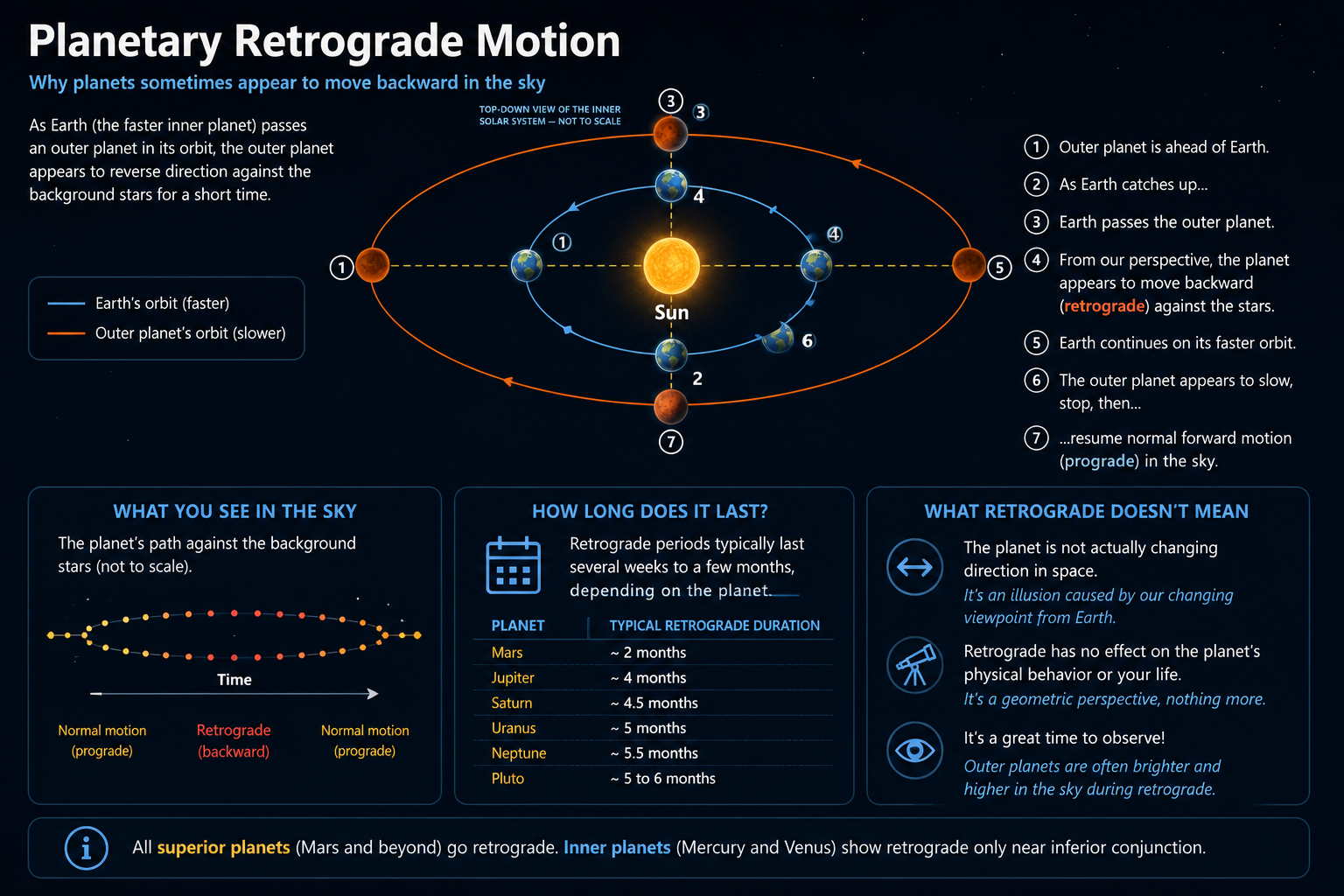
What Is Planetary Retrograde Motion?
Planetary retrograde motion is an apparent reversal in a planet’s movement against the background stars.
The planet does not physically stop and move backward in its orbit.
Retrograde motion happens because Earth and the other planets orbit the Sun at different speeds, changing our line of sight over time.
Why Retrograde Motion Matters
Retrograde motion is one of the classic observations that helped astronomers understand the true structure of the Solar System.
It demonstrates that Earth is also moving around the Sun rather than sitting motionless at the center of the universe.
For modern observers, retrograde loops are a useful way to track planetary motion over weeks or months.
What You Might See
On any single night, the planet will look normal.
The retrograde effect becomes obvious only when its position is compared over time.
Outer planets such as Mars, Jupiter, and Saturn can create noticeable retrograde loops against the background constellations.
How To Observe Retrograde Motion
Retrograde motion is not something you see happen in a few minutes at the eyepiece.
Instead, it is revealed by observing or photographing a planet repeatedly over many nights.
Mark the planet’s position relative to nearby stars, then compare those positions over time.
How to plan your observation
- Use a star chart or astronomy app to track the planet’s position.
- Observe the same planet several times over multiple weeks.
- Compare its position against nearby bright stars.
- Photograph the same region of sky repeatedly to build a retrograde motion sequence.
- Look for the planet to slow, reverse direction, then resume normal eastward motion.
The Science Behind Retrograde Motion
Retrograde motion is caused by relative orbital motion.
For outer planets, Earth catches up to and passes the planet in its faster inner orbit, making the outer planet appear to drift backward temporarily.
For inner planets such as Mercury and Venus, retrograde motion occurs as they pass between Earth and the Sun or move around the far side of the Sun.
Fun Fact
Retrograde motion was one of the major clues that helped replace Earth-centered models with Sun-centered models of the Solar System.
It is a perspective effect, not a mysterious force acting on the planet.
What to remember
Retrograde motion has no proven effect on human behavior, technology, or daily life.
Astronomically, it is a predictable visual effect caused by orbital geometry.
Common Questions About Saturn Ends Retrograde Motion
When does Saturn Ends Retrograde Motion occur?
Saturn Ends Retrograde Motion is listed for January 5, 2029.
Can I observe this event from my location?
Visibility depends on your location, local horizon, weather, and timing. Use Ephemeris with your saved observing location to check conditions.
What equipment should I use?
Naked eye, star chart, binoculars, or camera
