
Saturn at Opposition
Monday, October 30, 2028
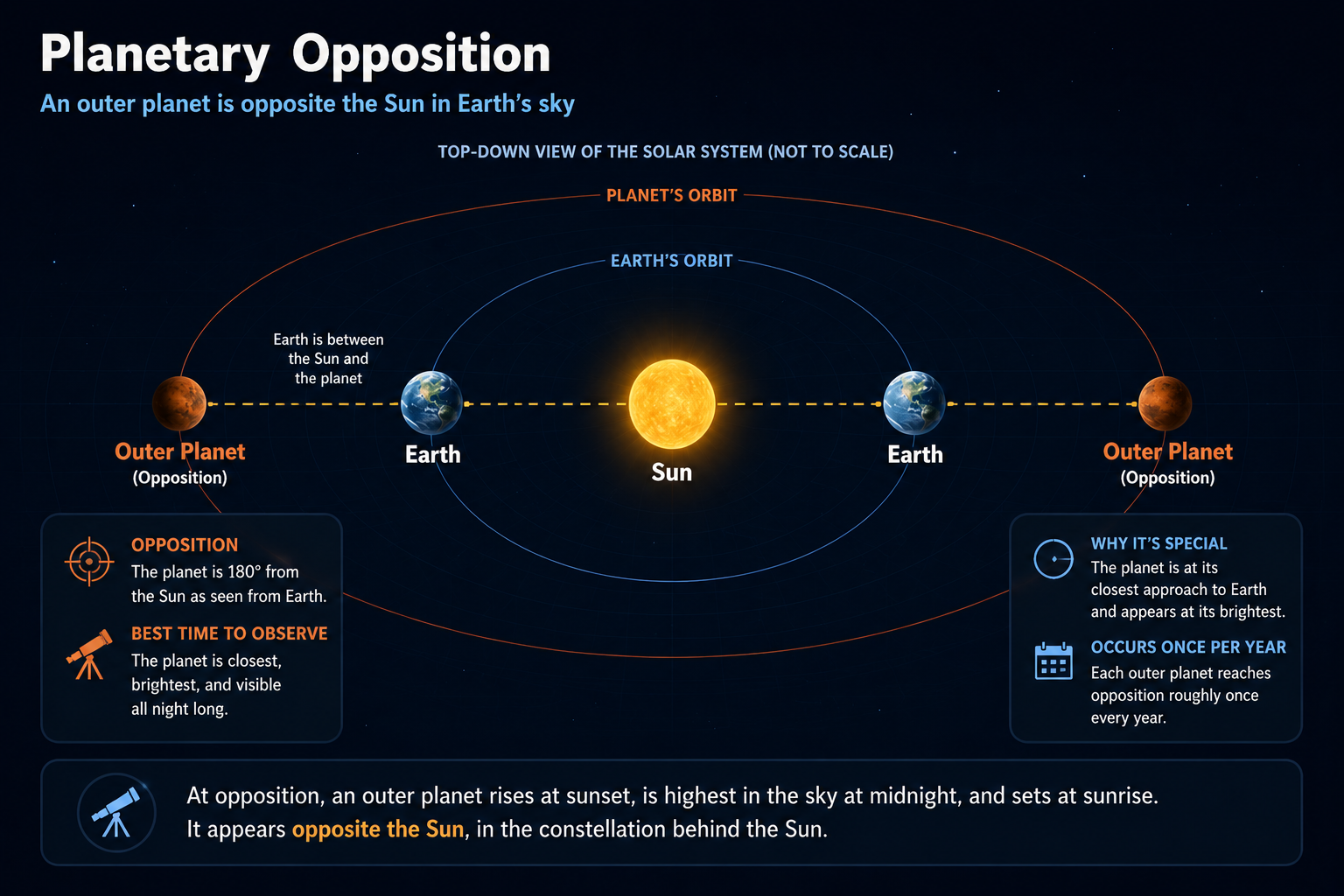
Opposition occurs when an outer Solar System object appears opposite the Sun in Earth’s sky. At opposition, Earth is positioned roughly between the Sun and the object. This geometry means the object rises around sunset, remains visible for much of the night, and sets around sunrise. For planets, asteroids, and some distant objects, opposition is often the best observing period of the year.
What Is Opposition?
Opposition occurs when an outer Solar System object appears opposite the Sun in Earth’s sky.
At opposition, Earth is positioned roughly between the Sun and the object.
This geometry means the object rises around sunset, remains visible for much of the night, and sets around sunrise.
For planets, asteroids, and some distant objects, opposition is often the best observing period of the year.
Why Opposition Matters
Objects at opposition are usually well placed for nighttime observing.
They are often near their brightest and largest apparent size because they are relatively close to Earth for that part of their orbit.
The all-night visibility makes opposition especially useful for telescope observing, imaging, and planning public astronomy sessions.
For planets, opposition can reveal the best telescopic detail of the observing season.
What You Might See
A planet at opposition may show its best disk size, brightness, and telescopic detail of the season.
The object will not visibly change moment by moment, but its placement makes it easier to observe for long periods.
Asteroids reveal their identity through motion against the background stars over hours or days.
How To Observe an Opposition Event
Look for the object after it rises in the evening and improves in altitude later in the night.
The best views usually occur when the object is highest above the horizon, often around local midnight.
A telescope is recommended for most opposition events, although some bright planets are obvious to the naked eye.
Use a finder chart or planetarium app to identify the object precisely, especially for asteroids.
How to plan your observation
- Observe when the object is highest in the sky.
- Avoid low-altitude views through haze and turbulent air.
- Use a telescope for detail or for faint asteroid targets.
- Check the object’s brightness and constellation before observing.
- For asteroids, sketch or photograph the field over multiple nights to see motion.
The Science Behind Opposition
Opposition is a geometry event involving the Sun, Earth, and an outer object.
Only objects outside Earth’s orbit can reach opposition because inner planets such as Mercury and Venus never appear opposite the Sun from Earth.
The geometry places the object in the nighttime sky and often near its closest approach to Earth for that orbit.
This is why opposition dates are important in both amateur observing and professional ephemeris planning.
Fun Fact
At opposition, an object is generally visible for the longest stretch of the night.
That is why opposition is often the date astronomers circle when planning planetary or asteroid observations.
What to remember
Opposition does not mean the object suddenly becomes spectacular overnight.
The best observing window usually spans days or weeks around the exact opposition date.
Weather, altitude, seeing, light pollution, and telescope size still determine how good the view will be.
Common Questions About Saturn at Opposition
When does Saturn at Opposition occur?
Saturn at Opposition is listed for October 30, 2028.
Can I observe this event from my location?
Visibility depends on your location, local horizon, weather, and timing. Use Ephemeris with your saved observing location to check conditions.
What equipment should I use?
Naked eye or telescope
