
Venus at Greatest Brightness
Thursday, April 27, 2028
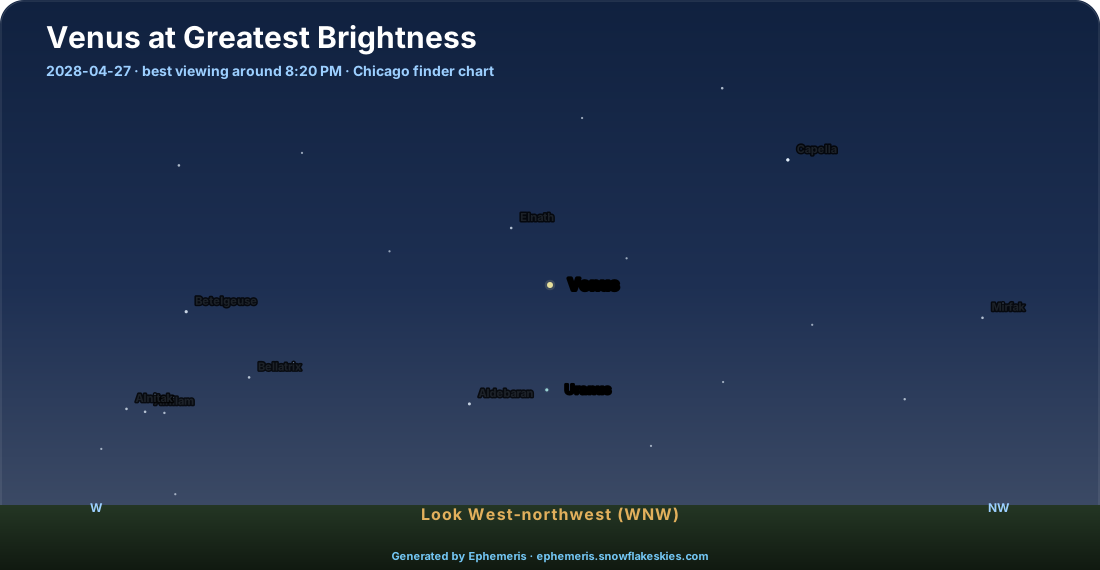
A planetary brightness event occurs when a planet reaches a notable brightness in Earth’s sky. This can happen because of distance, phase, illumination, and viewing geometry. For planets such as Venus, brightness depends on both its distance from Earth and how much of its sunlit side faces us. For outer planets, brightness is often greatest when the planet is near opposition and relatively close to Earth.
What Is a Planetary Brightness Event?
A planetary brightness event occurs when a planet reaches a notable brightness in Earth’s sky.
This can happen because of distance, phase, illumination, and viewing geometry.
For planets such as Venus, brightness depends on both its distance from Earth and how much of its sunlit side faces us.
For outer planets, brightness is often greatest when the planet is near opposition and relatively close to Earth.
Why Planetary Brightness Matters
Brightness events help observers know when a planet is especially easy to find.
They are useful for beginners because a very bright planet can stand out even in twilight or light-polluted skies.
These events also help explain why planets change brightness over weeks and months instead of remaining constant like most stars.
For photographers and telescope users, brightness can affect exposure settings and observing comfort.
What You Might See
A bright planet usually looks like a steady star-like point to the naked eye.
Venus can be dazzlingly bright and may even be visible in daylight under ideal conditions if you know exactly where to look.
Through a telescope, Venus shows phases, Jupiter shows cloud belts and moons, Saturn shows rings, and Mars may show color and occasional surface markings.
How To Observe a Bright Planet
Look in the direction and time window listed for the event.
Bright planets often appear steady compared with twinkling stars.
Venus and Jupiter can be unmistakable, while Mars and Saturn may require more careful identification depending on the season.
A telescope can reveal phases, disks, moons, rings, or surface color depending on the planet.
How to plan your observation
- Check whether the planet is visible before sunrise, after sunset, or during the night.
- Use a clear horizon if the planet is near twilight.
- Compare the planet’s brightness with nearby stars.
- Use binoculars to help locate the planet in twilight.
- Use a telescope for planetary detail once the planet is higher in the sky.
The Science Behind Planet Brightness
A planet’s brightness depends on its distance from Earth, distance from the Sun, size, reflectivity, and phase angle.
Inner planets can show dramatic phase changes, while outer planets are brightest when Earth passes between them and the Sun near opposition.
Astronomers measure brightness using magnitude, where smaller or more negative numbers mean brighter objects.
Fun Fact
Venus can become so bright that it casts faint shadows under very dark skies.
It is often mistaken for an aircraft, satellite, or unusual light because it can appear surprisingly intense in twilight.
What to remember
A brightness event does not always mean the best telescopic detail.
For example, Venus can be brightest when it is a large crescent rather than a full-looking disk.
Atmospheric turbulence, altitude, and glare still affect the view.
Common Questions About Venus at Greatest Brightness
When does Venus at Greatest Brightness occur?
Venus at Greatest Brightness is listed for April 27, 2028.
Can I observe this event from my location?
Visibility depends on your location, local horizon, weather, and timing. Use Ephemeris with your saved observing location to check conditions.
What equipment should I use?
Naked eye, binoculars, or telescope
