
Mercury at Dichotomy
Thursday, July 15, 2027
Planetary dichotomy occurs when a planet appears approximately half illuminated as seen from Earth. The word “dichotomy” means divided into two parts, and in astronomy it usually describes a planet showing a half-lit disk. This is most important for the inner planets, Mercury and Venus, because they orbit closer to the Sun than Earth does. Like the Moon, Mercury and Venus show phases because we see different portions of their sunlit sides as they move around the Sun.
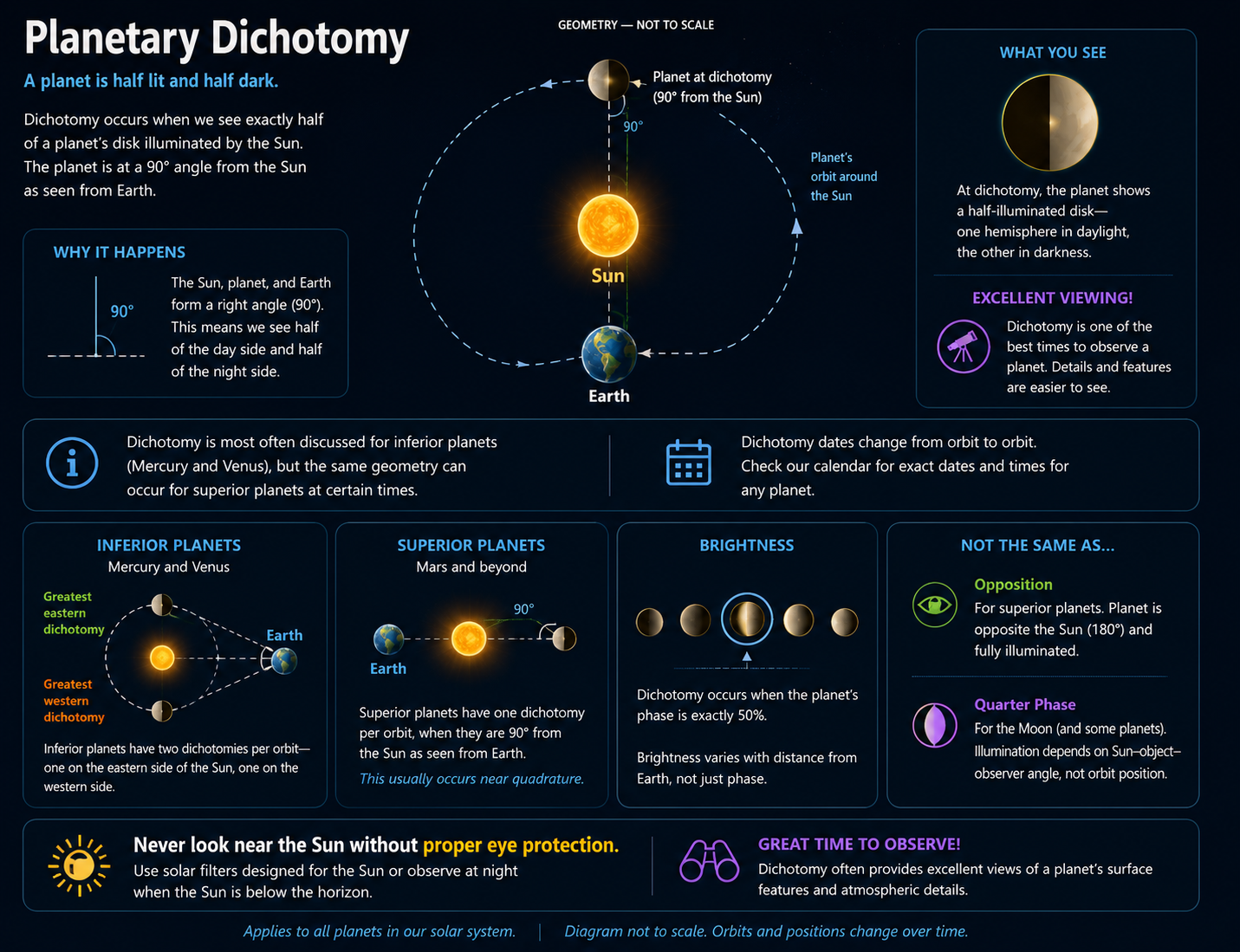
What Is Planetary Dichotomy?
Planetary dichotomy occurs when a planet appears approximately half illuminated as seen from Earth.
The word “dichotomy” means divided into two parts, and in astronomy it usually describes a planet showing a half-lit disk.
This is most important for the inner planets, Mercury and Venus, because they orbit closer to the Sun than Earth does.
Like the Moon, Mercury and Venus show phases because we see different portions of their sunlit sides as they move around the Sun.
Why Dichotomy Matters
Dichotomy is one of the clearest reminders that planets are worlds reflecting sunlight, not self-luminous points like stars.
Through a telescope, Venus and Mercury can change from crescent to half phase to gibbous over time.
These changing phases helped confirm the heliocentric model of the Solar System because they match the geometry of planets orbiting the Sun.
For observers, dichotomy is a useful event for connecting telescope views with real orbital motion.
What You Might See
Venus may appear as a bright half disk, similar in shape to a First Quarter or Last Quarter Moon.
Mercury can also show a half phase, but its small size and low altitude often make the view more challenging.
The planet will not show surface detail like the Moon. Instead, the key feature is the shape of the illuminated disk.
Atmospheric turbulence can make the edge of the planet shimmer, so patience is important.
How To Observe Planetary Dichotomy
A telescope is usually required to see planetary dichotomy clearly.
Venus is the easiest planet for observing phases because it is bright and shows a relatively large apparent disk.
Mercury is more difficult because it is smaller, lower in the sky, and usually closer to the Sun from our viewpoint.
The safest and most comfortable time to observe is when the planet is well separated from the Sun and high enough above the horizon to reduce atmospheric distortion.
How to plan your observation
- Use a telescope at moderate magnification.
- Observe when the planet is safely above the horizon.
- Never point binoculars or a telescope near the Sun.
- Try observing during twilight for Venus, when glare is reduced and the planet is easier to locate.
- Wait for moments of steady seeing to judge the phase accurately.
- Compare the planet’s appearance over several days or weeks to watch the phase change.
The Science Behind Planetary Phases
Planetary phases occur because planets shine by reflecting sunlight.
When an inner planet is positioned so that we see about half of its sunlit hemisphere, it is near dichotomy.
The exact moment of geometric dichotomy does not always match the visually observed half phase because atmospheres, scattering, and observational effects can shift the apparent phase slightly.
Venus is especially famous for this effect, which is known as the Schröter effect.
Fun Fact
Galileo’s telescopic observations of Venus showing phases were powerful evidence that Venus orbits the Sun.
The changing shape of Venus was difficult to explain under older Earth-centered models but naturally follows from the Sun-centered Solar System.
What to remember
Planetary dichotomy is not usually dramatic to the naked eye.
The planet may look like a bright star without a telescope.
The half-lit shape becomes visible only with enough magnification and steady atmospheric conditions.
For Mercury especially, safety and timing matter because the planet is never far from the Sun in the sky.
Common Questions About Mercury at Dichotomy
When does Mercury at Dichotomy occur?
Mercury at Dichotomy is listed for July 15, 2027.
Can I observe this event from my location?
Visibility depends on your location, local horizon, weather, and timing. Use Ephemeris with your saved observing location to check conditions.
What equipment should I use?
Telescope
