
Mercury at Superior Conjunction
Thursday, August 27, 2026
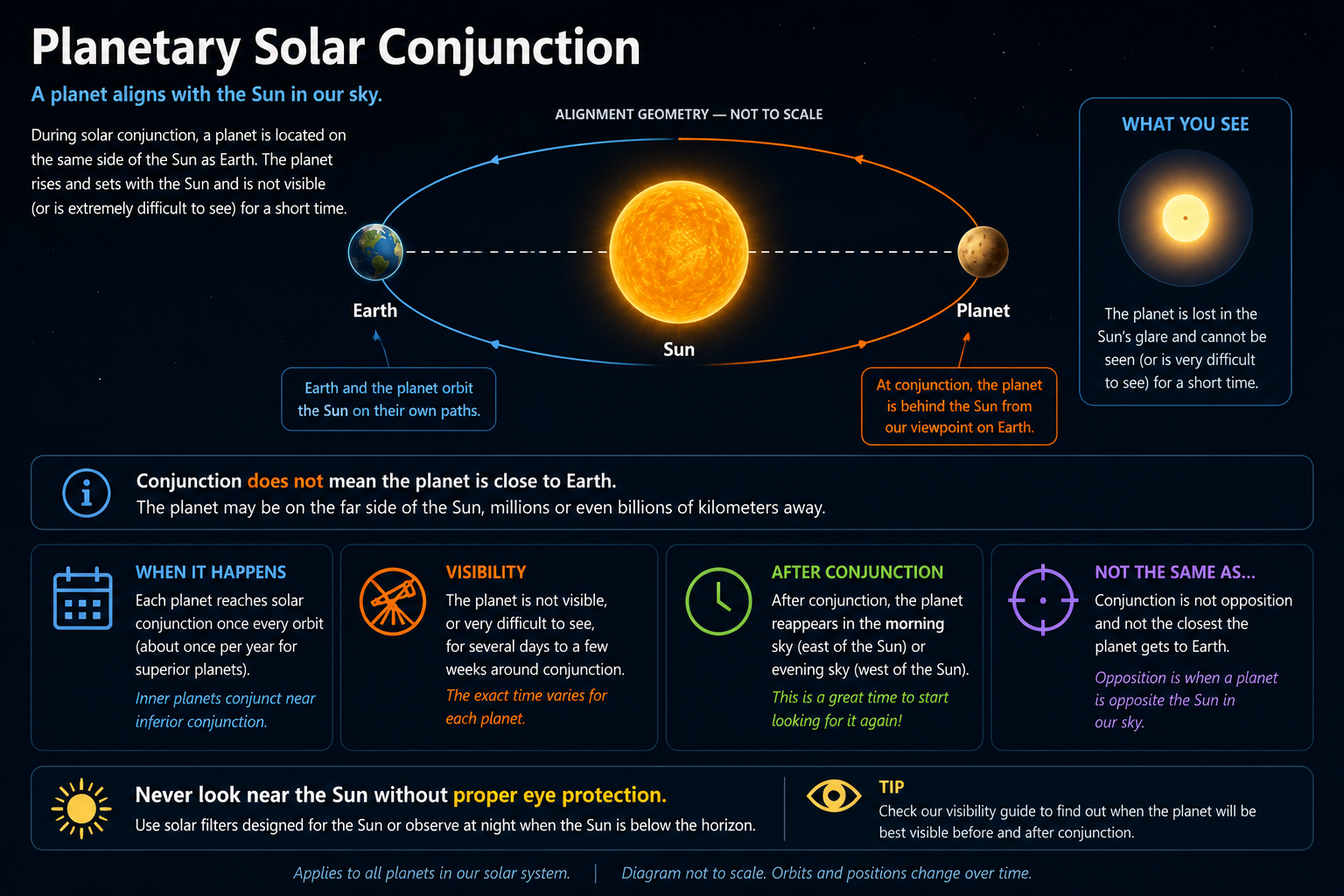
A planetary solar conjunction occurs when a planet appears close to the Sun in Earth’s sky. The planet may pass behind the Sun, near the Sun, or between Earth and the Sun depending on the planet and event type. Because the planet is lost in solar glare, solar conjunctions are usually poor observing events.
What Is a Solar Conjunction?
A planetary solar conjunction occurs when a planet appears close to the Sun in Earth’s sky.
The planet may pass behind the Sun, near the Sun, or between Earth and the Sun depending on the planet and event type.
Because the planet is lost in solar glare, solar conjunctions are usually poor observing events.
Why Solar Conjunctions Matter
Solar conjunctions are useful orbital markers even though they are usually not good visual events.
They help define the beginning or end of a planet’s observing season.
After conjunction, a planet may gradually emerge into the morning or evening sky as its angular separation from the Sun increases.
What You Might See
Usually, you will not see the planet at conjunction.
It is hidden in the Sun’s glare or positioned too close to the Sun for safe observing.
The important change happens afterward, as the planet slowly reappears in morning or evening twilight.
How To Treat This Event as an Observer
In most cases, do not attempt to observe a planet at solar conjunction.
The planet is too close to the Sun from our point of view, and looking near the Sun with binoculars or a telescope is extremely dangerous.
Instead, use the conjunction date as a planning marker for when the planet will return to visibility in the weeks ahead.
How to plan your observation
- Do not point binoculars or a telescope near the Sun.
- Wait until the planet has separated safely from the Sun before attempting observation.
- Check whether the planet will return to the morning or evening sky after conjunction.
- Use this date to plan future elongation, opposition, or visibility windows.
The Science Behind Solar Conjunctions
A conjunction is a line-of-sight alignment in the sky.
Solar conjunctions occur when a planet and the Sun share nearly the same apparent direction from Earth.
For outer planets, conjunction usually means the planet is on the far side of the Sun. For inner planets, conjunction can occur when the planet is between Earth and the Sun or beyond the Sun.
Fun Fact
Spacecraft communications can be affected during some solar conjunctions because radio signals must pass close to the Sun from Earth’s perspective.
Mission teams often plan around these communication challenges.
What to remember
Never use binoculars or a telescope to search for a planet near the Sun unless you are using proper solar observing equipment and know exactly what you are doing.
Accidental solar viewing through optics can cause permanent eye damage.
Common Questions About Mercury at Superior Conjunction
When does Mercury at Superior Conjunction occur?
Mercury at Superior Conjunction is listed for August 27, 2026.
Can I observe this event from my location?
Visibility depends on your location, local horizon, weather, and timing. Use Ephemeris with your saved observing location to check conditions.
What equipment should I use?
Not recommended for direct observing
