
Total Solar Eclipse
Friday, November 14, 2031
A solar eclipse occurs when the Moon passes between Earth and the Sun and blocks part or all of the Sun from view. Depending on the alignment and the observer’s location, the eclipse may be partial, annular, or total. Solar eclipses are location dependent. The same eclipse can look very different from different places on Earth. A total solar eclipse is visible only along a narrow path where the Moon completely covers the Sun.
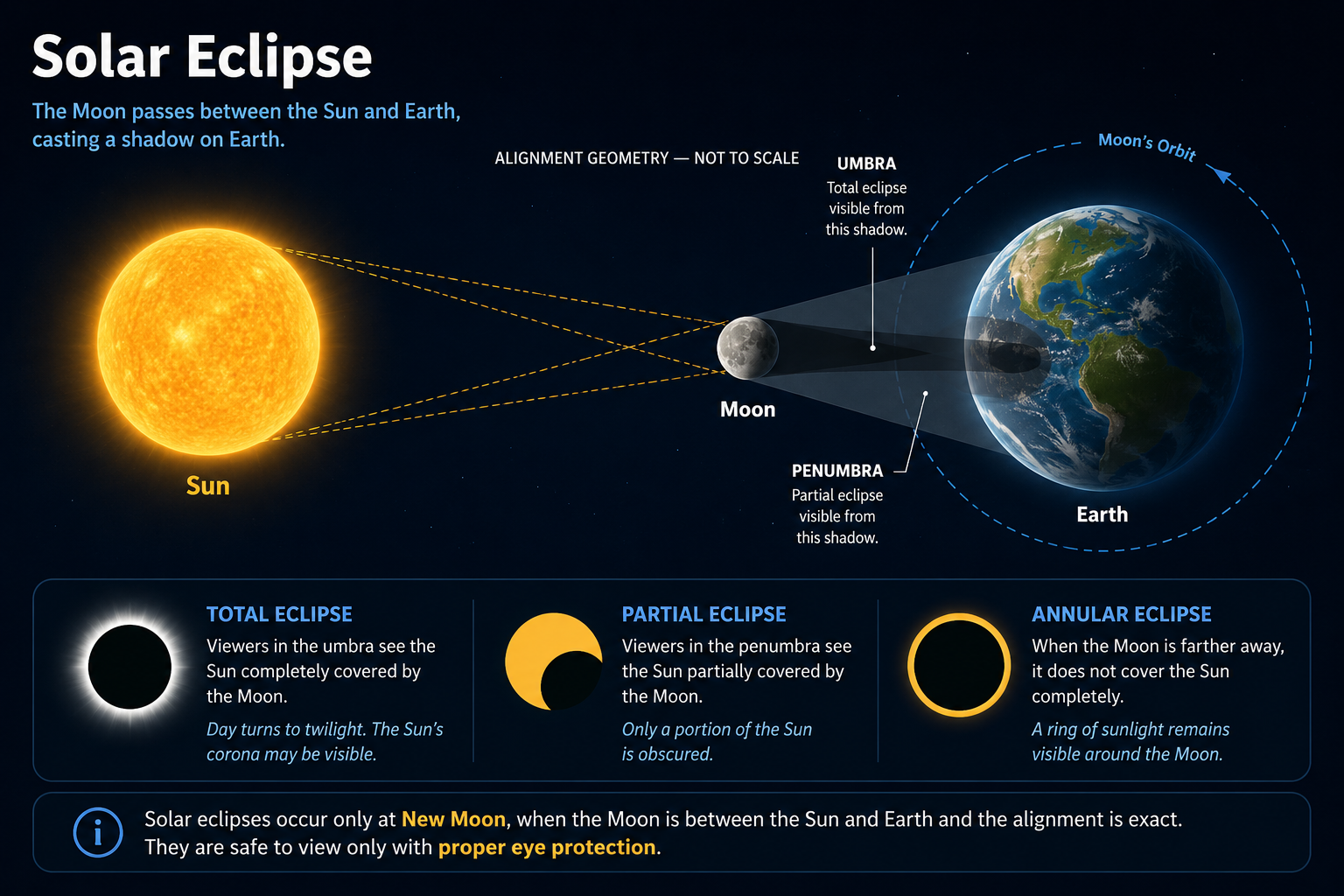
What Is a Solar Eclipse?
A solar eclipse occurs when the Moon passes between Earth and the Sun and blocks part or all of the Sun from view.
Depending on the alignment and the observer’s location, the eclipse may be partial, annular, or total.
Solar eclipses are location dependent. The same eclipse can look very different from different places on Earth.
A total solar eclipse is visible only along a narrow path where the Moon completely covers the Sun.
Why Solar Eclipses Matter
Solar eclipses reveal the precise geometry of the Sun, Moon, and Earth.
Total solar eclipses briefly reveal the Sun’s outer atmosphere, called the corona, which is normally hidden by the Sun’s bright surface.
Eclipses have played important roles in astronomy history, from testing orbital predictions to studying the Sun’s atmosphere.
They are also unforgettable public sky events when viewed safely from the right location.
What You Might See
During a partial eclipse, the Sun appears as though a dark bite has been taken from its disk.
During an annular eclipse, the Moon appears too small to cover the Sun completely, leaving a bright ring of sunlight around it.
During a total eclipse, the sky darkens, planets may become visible, and the Sun’s corona appears around the black disk of the Moon.
How To Observe a Solar Eclipse Safely
Never look directly at the Sun without proper solar eclipse glasses or a certified solar filter.
Regular sunglasses, smoked glass, exposed film, and improvised filters are not safe for solar viewing.
Binoculars, telescopes, and camera lenses require proper front-mounted solar filters before being pointed at the Sun.
During a total solar eclipse, the only time it is safe to look without filters is during the brief period of totality, and only from within the path of totality.
How to plan your observation
- Confirm whether the eclipse is visible from your location.
- Use certified solar eclipse glasses for direct viewing.
- Use proper solar filters on cameras, binoculars, and telescopes.
- Do not use optical equipment with eclipse glasses unless the equipment has its own solar filter.
- Plan your location early for total eclipses because the path of totality is narrow.
- Check weather and cloud forecasts carefully.
The Science Behind Solar Eclipses
Solar eclipses occur only at New Moon, but not every New Moon produces an eclipse.
The Moon’s orbit is tilted relative to Earth’s orbit around the Sun, so the alignment has to occur near one of the Moon’s orbital nodes.
The type of eclipse depends on the Moon’s apparent size and the observer’s location within the eclipse shadow.
The narrow central shadow path explains why total solar eclipses are rare from any single location.
Fun Fact
The Sun is about 400 times wider than the Moon, but it is also about 400 times farther away.
That coincidence makes the Sun and Moon appear nearly the same size in our sky, allowing total solar eclipses to happen.
What to remember
Solar eclipses require serious eye safety.
Permanent eye damage can occur from looking at the Sun without proper protection, even when most of the Sun is covered.
If you are unsure whether your equipment is safe, do not use it for direct solar viewing.
Common Questions About Total Solar Eclipse
When does Total Solar Eclipse occur?
Total Solar Eclipse is listed for November 14, 2031.
Can I observe this event from my location?
Visibility depends on your location, local horizon, weather, and timing. Use Ephemeris with your saved observing location to check conditions.
What equipment should I use?
Certified solar viewing protection
