
Partial Lunar Eclipse
Thursday, July 6, 2028
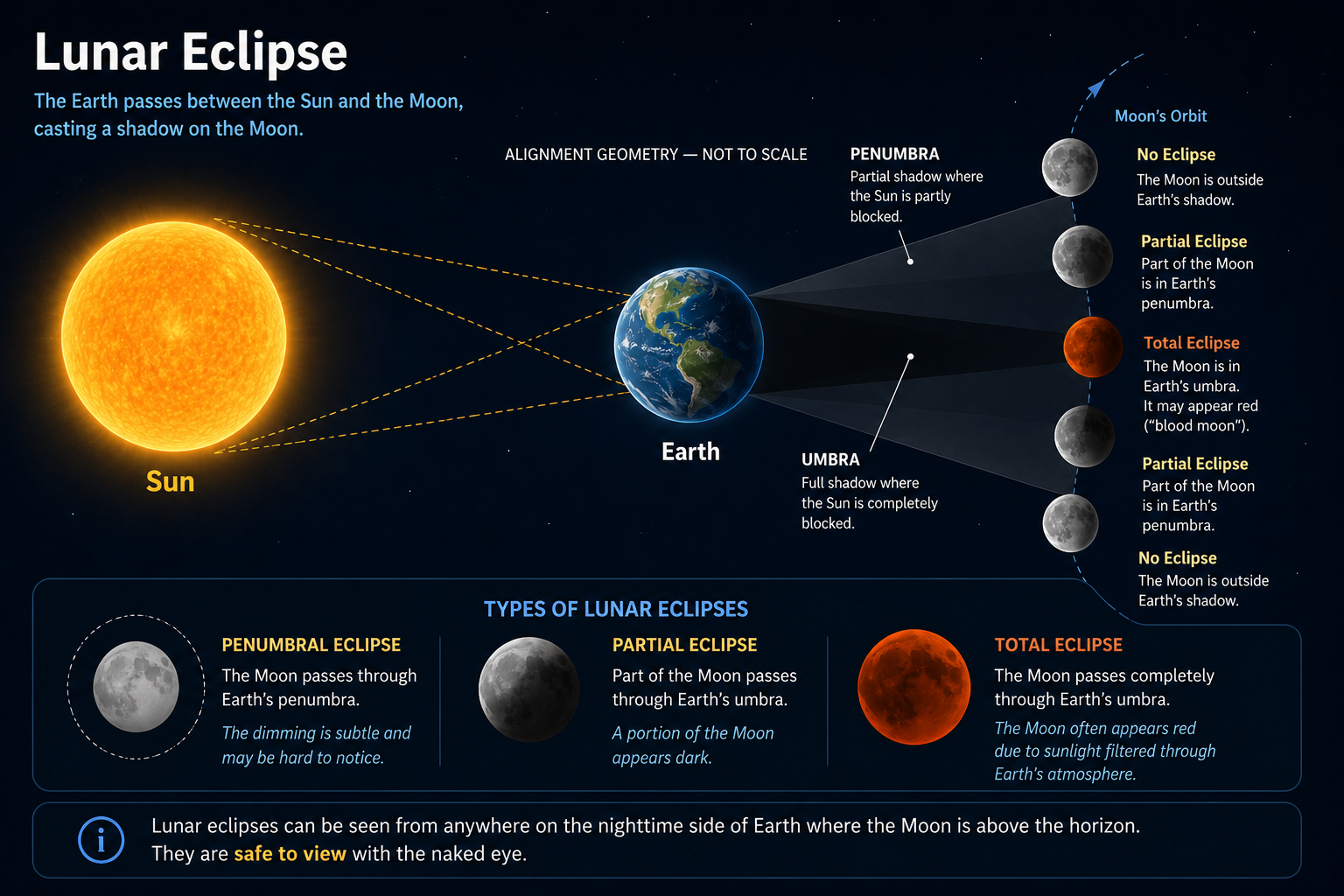
A lunar eclipse occurs when the Moon passes through Earth’s shadow. This can happen only at Full Moon, when the Sun, Earth, and Moon line up with Earth in the middle. Lunar eclipses may be penumbral, partial, or total depending on how deeply the Moon enters Earth’s shadow. Unlike solar eclipses, lunar eclipses are safe to view with the naked eye.
What Is a Lunar Eclipse?
A lunar eclipse occurs when the Moon passes through Earth’s shadow.
This can happen only at Full Moon, when the Sun, Earth, and Moon line up with Earth in the middle.
Lunar eclipses may be penumbral, partial, or total depending on how deeply the Moon enters Earth’s shadow.
Unlike solar eclipses, lunar eclipses are safe to view with the naked eye.
Why Lunar Eclipses Matter
Lunar eclipses are among the most accessible major astronomy events.
They require no special eye protection and can often be watched from anywhere on the nighttime side of Earth.
During a total lunar eclipse, the Moon can take on a dramatic red or copper color as sunlight filters through Earth’s atmosphere.
The event is a visible demonstration of Earth’s shadow extending into space.
What You Might See
During a partial eclipse, Earth’s dark umbral shadow appears to take a bite out of the Moon.
During totality, the Moon may turn red, orange, copper, or brown depending on Earth’s atmosphere.
The exact color and brightness can vary from one eclipse to another because dust, clouds, and volcanic aerosols in Earth’s atmosphere affect the filtered sunlight.
How To Observe a Lunar Eclipse
Check the local eclipse timing for your location, including the start, maximum, and end of the eclipse.
Find a location with a clear view of the Moon and minimal obstructions.
No special equipment is required, although binoculars or a telescope can enhance the view.
The most dramatic stages occur during partial and total eclipse phases.
How to plan your observation
- Check whether the eclipse is visible from your location.
- Note the timing of partial eclipse, totality, and maximum eclipse.
- Use binoculars to watch the shadow move across the lunar surface.
- Photograph the Moon at intervals to show the eclipse progression.
- Dress warmly if observing late at night for an extended period.
The Science Behind Lunar Eclipses
Earth casts two shadows into space: a faint outer penumbra and a darker inner umbra.
A penumbral eclipse occurs when the Moon passes through the outer shadow. A partial eclipse occurs when part of the Moon enters the umbra. A total eclipse occurs when the entire Moon enters the umbra.
The red color during totality happens because Earth’s atmosphere bends and filters sunlight into the shadow, scattering shorter blue wavelengths and allowing redder light to reach the Moon.
Fun Fact
A totally eclipsed Moon is sometimes called a Blood Moon because of its reddish color.
The color is actually sunlight filtered through Earth’s atmosphere — essentially the light of all Earth’s sunrises and sunsets projected onto the Moon.
What to remember
Not all lunar eclipses are dramatic.
Penumbral eclipses can be subtle and difficult to notice without careful comparison.
Clouds, haze, and low altitude can reduce the view, even though the eclipse itself is safe and easy to observe.
Common Questions About Partial Lunar Eclipse
When does Partial Lunar Eclipse occur?
Partial Lunar Eclipse is listed for July 6, 2028.
Can I observe this event from my location?
Visibility depends on your location, local horizon, weather, and timing. Use Ephemeris with your saved observing location to check conditions.
What equipment should I use?
Naked eye, binoculars, or telescope
