
Comet C/2025 R3 (PANSTARRS) reaches perihelion
Sunday, April 19, 2026
Perihelion is the point in a comet’s orbit when it is closest to the Sun. As a comet approaches the Sun, solar heating can cause ice to vaporize and release dust and gas. That activity can create a glowing coma and sometimes one or more tails. Perihelion does not always mean the comet is closest to Earth or easiest to observe from your location.
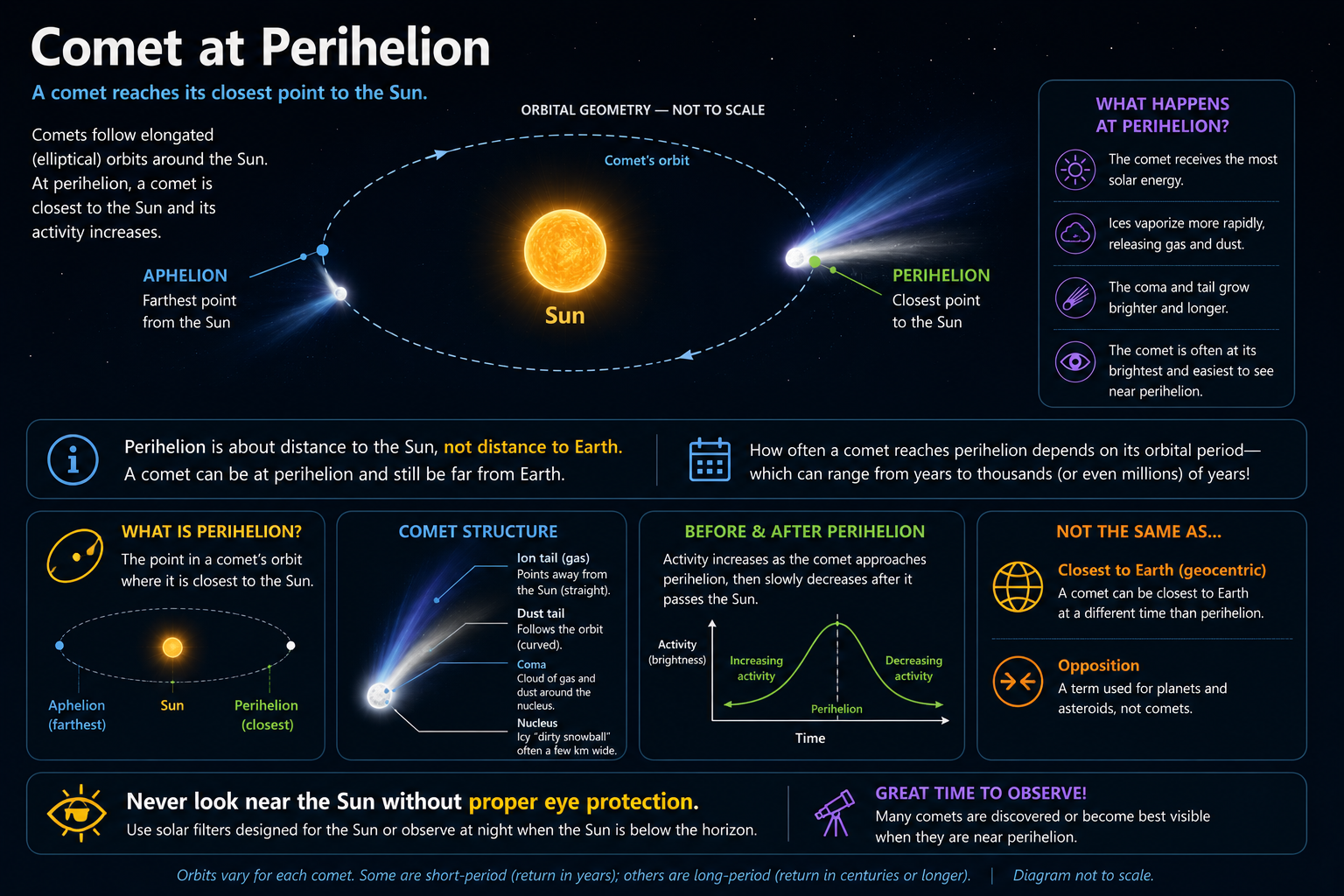
What Is Comet Perihelion?
Perihelion is the point in a comet’s orbit when it is closest to the Sun.
As a comet approaches the Sun, solar heating can cause ice to vaporize and release dust and gas.
That activity can create a glowing coma and sometimes one or more tails.
Perihelion does not always mean the comet is closest to Earth or easiest to observe from your location.
Why Perihelion Matters
Comets often become most active near perihelion because sunlight heats their icy surfaces more strongly.
Increased activity can make a comet brighter, more diffuse, and more likely to show a tail.
Perihelion is an important planning date, but visibility also depends on the comet’s distance from Earth, its position relative to the Sun, and its altitude in the sky.
Some comets brighten dramatically near perihelion, while others remain faint or disappoint observers.
What You Might See
A comet may appear as a faint fuzzy patch, a condensed glow, or a bright object with a visible tail depending on its activity and brightness.
Most comets are subtle through small instruments, even when they are scientifically interesting.
Photographs often reveal tails and color more clearly than the eye can see visually.
How To Observe a Comet Near Perihelion
Check current brightness estimates and finder charts before observing.
Comets can change rapidly, so recent observations are more useful than old predictions.
Use binoculars or a telescope unless the comet is predicted to become bright enough for naked-eye viewing.
Dark skies and good transparency are especially important for seeing faint comet tails and diffuse coma structure.
How to plan your observation
- Use an up-to-date finder chart.
- Check recent magnitude estimates before heading out.
- Observe from a dark site if possible.
- Start with binoculars or a low-power telescope view.
- Look for a fuzzy glow rather than a sharp star-like point.
- Revisit the comet over multiple nights to watch its motion and changing appearance.
The Science Behind Perihelion
Comets are icy bodies left over from the formation of the Solar System.
When they approach the Sun, heat causes volatile materials to sublimate directly from ice into gas.
Escaping gas carries dust away from the nucleus, forming the coma and tail structures.
The solar wind and radiation pressure shape comet tails, often pushing them away from the Sun.
Fun Fact
A comet’s tail does not trail behind it like smoke from an airplane.
Comet tails generally point away from the Sun because they are shaped by sunlight and the solar wind.
What to remember
Comet brightness predictions are notoriously uncertain.
A comet can brighten unexpectedly, fade, fragment, or remain much dimmer than forecasts suggest.
Perihelion is important, but it is not a guarantee of a spectacular view.
Common Questions About Comet C/2025 R3 (PANSTARRS) reaches perihelion
When does Comet C/2025 R3 (PANSTARRS) reaches perihelion occur?
Comet C/2025 R3 (PANSTARRS) reaches perihelion is listed for April 19, 2026.
Can I observe this event from my location?
Visibility depends on your location, local horizon, weather, and timing. Use Ephemeris with your saved observing location to check conditions.
What equipment should I use?
Binoculars or telescope
