
Earth at Aphelion
Thursday, January 3, 2030
An Earth orbital event marks a notable point in Earth’s yearly path around the Sun. Common examples include perihelion, when Earth is closest to the Sun, and aphelion, when Earth is farthest from the Sun. These events are part of the regular rhythm of Earth’s orbit and help explain the geometry of our Solar System.
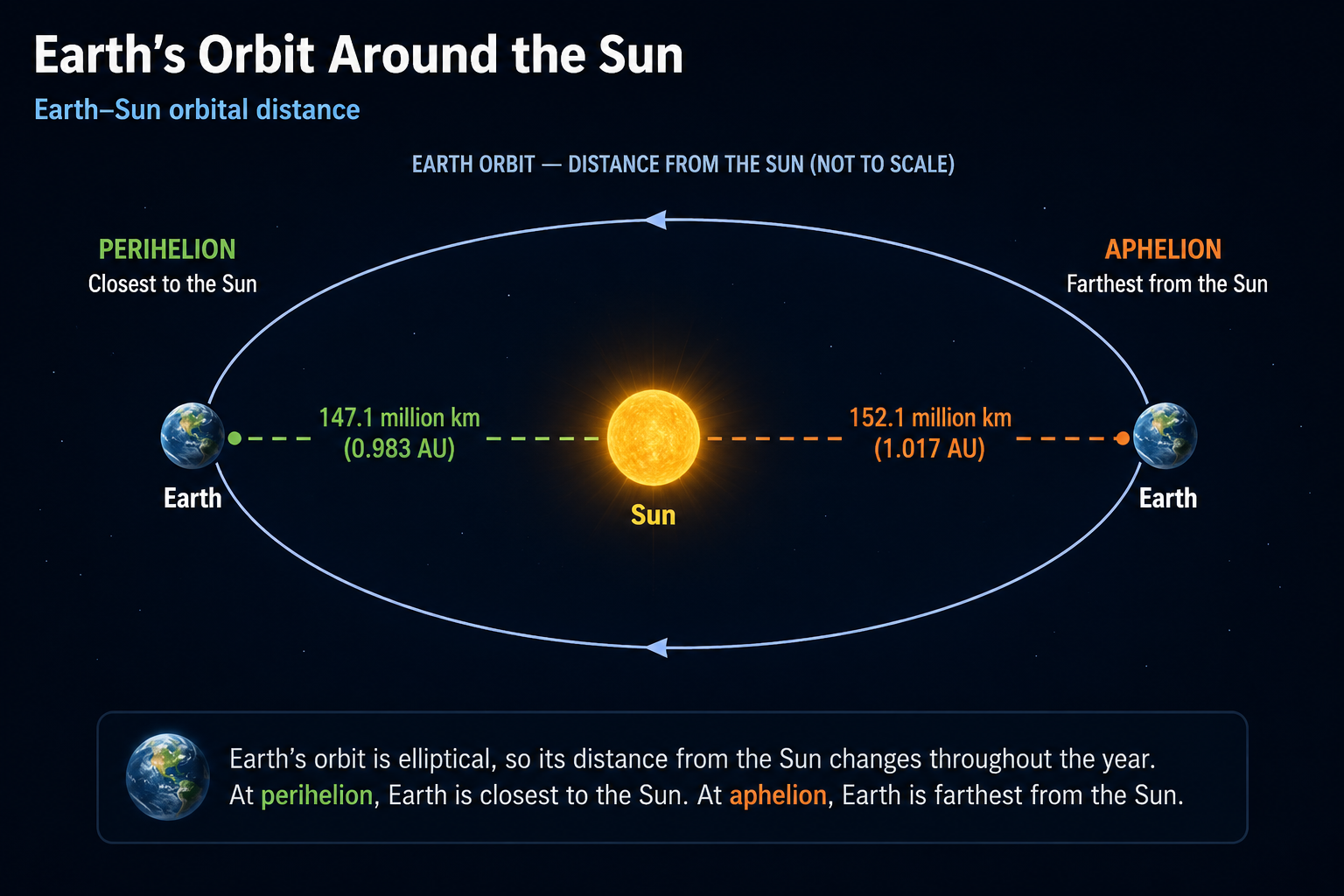
What Is an Earth Orbital Event?
An Earth orbital event marks a notable point in Earth’s yearly path around the Sun.
Common examples include perihelion, when Earth is closest to the Sun, and aphelion, when Earth is farthest from the Sun.
These events are part of the regular rhythm of Earth’s orbit and help explain the geometry of our Solar System.
Why Earth Orbital Events Matter
Earth’s orbit is slightly elliptical, so our distance from the Sun changes during the year.
These distance changes are real, but they are not the main cause of the seasons.
The seasons are caused primarily by Earth’s 23.5-degree axial tilt, not by how close Earth is to the Sun.
That makes Earth orbital events useful teaching moments for separating common myths from actual astronomy.
What You Might Notice
You generally will not notice a direct visual change on the event date itself.
The Sun’s apparent size changes slightly through the year, but the difference is too subtle for casual viewing and unsafe to check without proper solar equipment.
Seasonal changes in daylight and solar altitude are much more noticeable than Earth’s distance change.
How To Observe This Event
Earth orbital events are not usually visible as sudden changes in the sky.
You will not see the Sun dramatically change size from one day to the next.
Instead, use the event as a chance to understand Earth’s motion and how orbital geometry affects the calendar.
How to plan your observation
- Use this event as an educational marker rather than a visual target.
- Compare it with solstice and equinox dates to understand the difference between distance and tilt.
- Never observe the Sun directly without proper solar filters.
- Track sunrise, sunset, and daylight length through the season for a visible connection to Earth’s orbit and tilt.
The Science Behind Earth’s Orbit
Earth orbits the Sun in an ellipse, with the Sun slightly offset from the center of that ellipse.
At perihelion, Earth is closest to the Sun. At aphelion, Earth is farthest from the Sun.
Because Earth’s orbital eccentricity is small, the distance change is modest compared with the effect of axial tilt on seasons.
Fun Fact
Earth is closest to the Sun in early January, during winter in the Northern Hemisphere.
That surprising fact is one of the clearest demonstrations that seasons are caused by tilt, not distance from the Sun.
What to remember
Earth orbital events are scientifically important but not usually visual spectacles.
They are best understood as calendar and geometry milestones rather than observing targets.
Common Questions About Earth at Aphelion
When does Earth at Aphelion occur?
Earth at Aphelion is listed for January 3, 2030.
Can I observe this event from my location?
Visibility depends on your location, local horizon, weather, and timing. Use Ephemeris with your saved observing location to check conditions.
What equipment should I use?
No equipment needed for general understanding
