
June Solstice
Monday, June 21, 2027
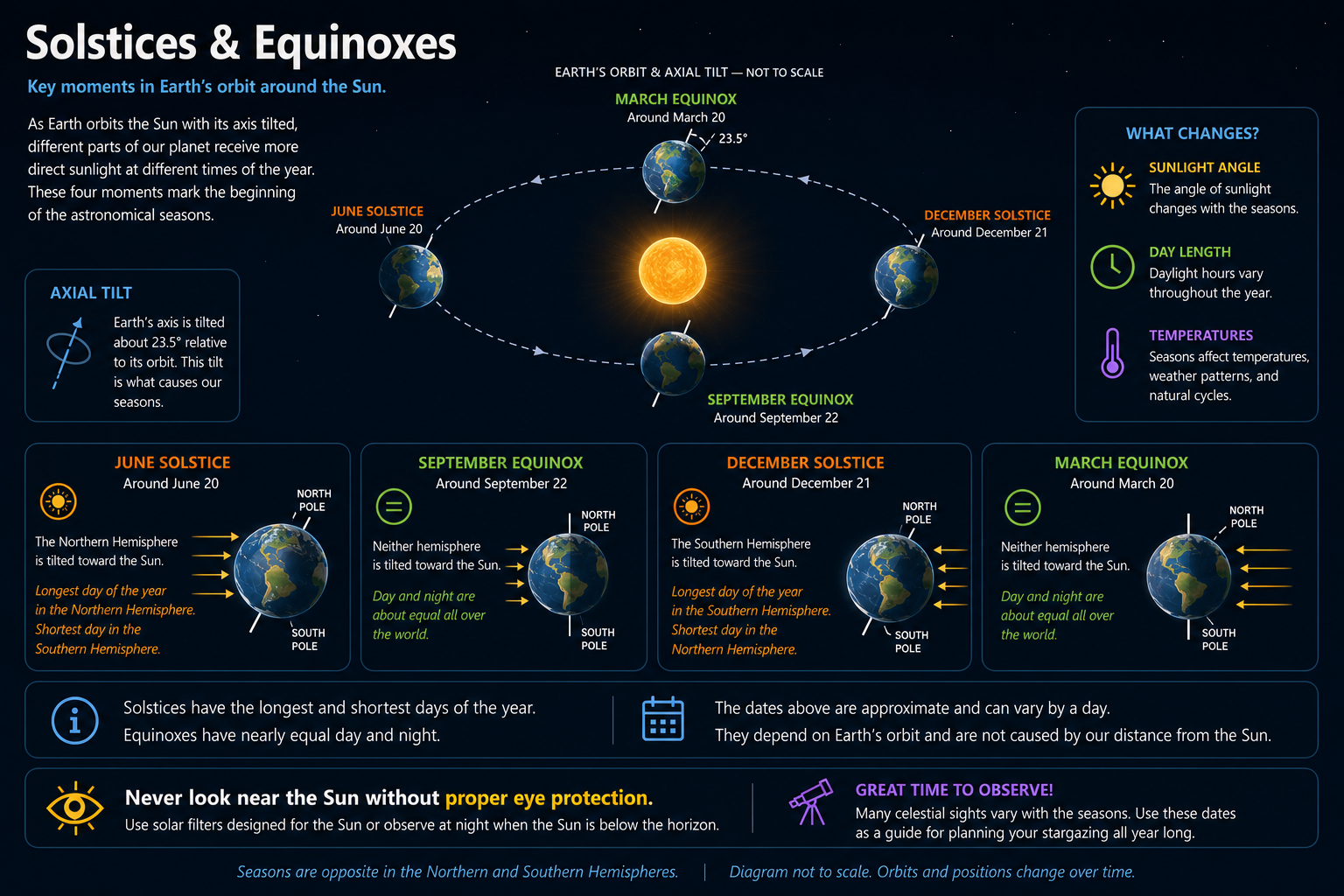
A solstice occurs when one of Earth’s hemispheres is tilted most strongly toward or away from the Sun. The June solstice brings the longest day of the year to the Northern Hemisphere and the shortest day to the Southern Hemisphere. The December solstice reverses that pattern, bringing the shortest Northern Hemisphere day and longest Southern Hemisphere day. A solstice is not an object to find in the sky. It is a marker of Earth’s position in its orbit around the Sun.
What Is a Solstice?
A solstice occurs when one of Earth’s hemispheres is tilted most strongly toward or away from the Sun.
The June solstice brings the longest day of the year to the Northern Hemisphere and the shortest day to the Southern Hemisphere.
The December solstice reverses that pattern, bringing the shortest Northern Hemisphere day and longest Southern Hemisphere day.
A solstice is not an object to find in the sky. It is a marker of Earth’s position in its orbit around the Sun.
Why This Event Matters
Seasonal markers connect everyday experience with astronomy.
They explain why daylight changes throughout the year, why the Sun rises and sets at different points on the horizon, and why seasons are opposite in the Northern and Southern Hemispheres.
They also help observers understand seasonal sky changes, including which constellations dominate evening skies at different times of year.
For ancient cultures, solstices and equinoxes were important for calendars, agriculture, navigation, and monuments aligned with the Sun.
What You Might Notice
Near a solstice, the Sun reaches one of its extreme sunrise and sunset positions along the horizon.
Near an equinox, sunrise and sunset occur closer to due east and due west for many locations.
The change is gradual rather than sudden, but it becomes obvious when tracked over weeks or months.
Night-sky observers may notice that seasonal constellations begin taking over the evening sky.
How To Experience It
A solstice or equinox is not something that flashes or changes suddenly in the sky.
Instead, it is best experienced by noticing the Sun’s changing path, the length of daylight, and the seasonal shift in evening constellations.
You can observe the event by tracking sunrise or sunset positions over time, noting shadow lengths at noon, or comparing daylight hours across the year.
How to plan your observation
- Notice where the Sun rises or sets on the horizon near the event date.
- Compare day length with dates one or two months before and after.
- Track the Sun’s noon altitude using shadows from a fixed object.
- Use the event as a reminder to look for the next season’s constellations.
- Never look directly at the Sun without proper solar safety equipment.
The Science Behind Seasons
Earth’s seasons are caused by its axial tilt of about 23.5 degrees, not by changing distance from the Sun.
As Earth orbits the Sun, that tilt changes how directly sunlight strikes each hemisphere and how long the Sun remains above the horizon each day.
Solstices occur at maximum tilt toward or away from the Sun. Equinoxes occur when the tilt is sideways relative to the Sun, giving both hemispheres more balanced sunlight.
Fun Fact
The word solstice comes from Latin roots meaning “Sun stands still.”
Near a solstice, the Sun’s rising and setting positions change very slowly from day to day before reversing direction along the horizon.
What to remember
A solstice or equinox is not a visible object or a one-second event like an occultation.
It is a precise moment in Earth-Sun geometry, but its effects are experienced gradually through daylight, seasons, and the Sun’s path.
Common Questions About June Solstice
When does June Solstice occur?
June Solstice is listed for June 21, 2027.
Can I observe this event from my location?
Visibility depends on your location, local horizon, weather, and timing. Use Ephemeris with your saved observing location to check conditions.
What equipment should I use?
No equipment needed
