
First Quarter Moon
Tuesday, February 24, 2026
A Moon phase describes how much of the Moon’s sunlit half is visible from Earth. The Moon is always half illuminated by the Sun, but from Earth we see that illuminated half from different angles as the Moon orbits our planet. This changing geometry creates the familiar sequence of New Moon, crescent, First Quarter, gibbous, Full Moon, Last Quarter, and back again. A complete cycle of lunar phases takes about 29.5 days and is called a synodic month.
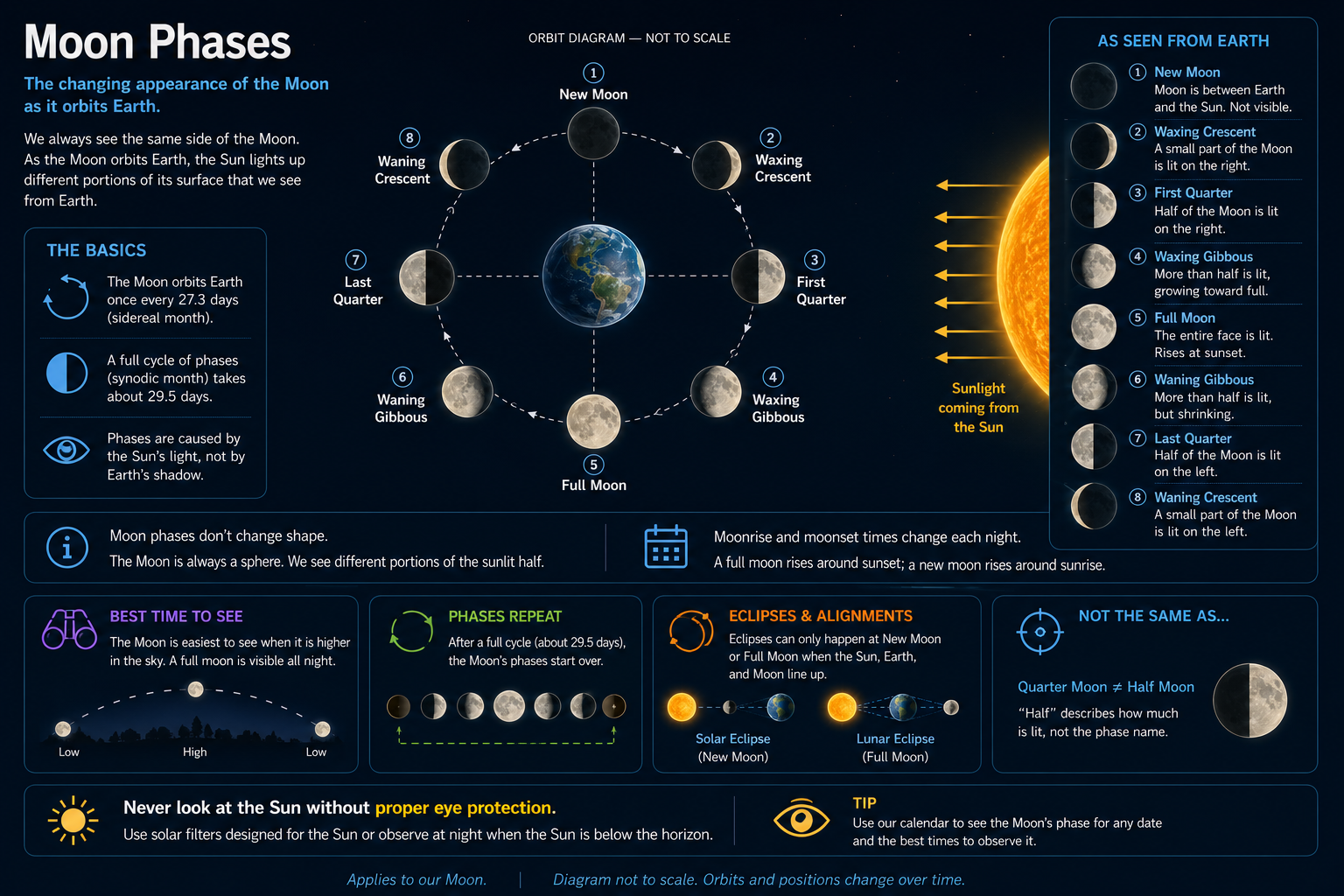
What Is a Moon Phase?
A Moon phase describes how much of the Moon’s sunlit half is visible from Earth.
The Moon is always half illuminated by the Sun, but from Earth we see that illuminated half from different angles as the Moon orbits our planet.
This changing geometry creates the familiar sequence of New Moon, crescent, First Quarter, gibbous, Full Moon, Last Quarter, and back again.
A complete cycle of lunar phases takes about 29.5 days and is called a synodic month.
Why Moon Phases Matter
Moon phase is one of the most important planning factors for astronomy observing.
A bright Moon can wash out faint stars, galaxies, nebulae, and the Milky Way, especially when it is high in the sky.
New Moon periods are usually best for deep-sky observing and astrophotography because the sky is darkest.
Quarter phases are often excellent for studying the Moon itself because low-angle sunlight casts shadows across craters, mountains, valleys, and ridges.
What You Might See
A crescent Moon shows a thin curved slice of sunlight and often reveals earthshine on the darker portion of the lunar disk.
Quarter phases show dramatic shadows along the terminator, the boundary between lunar day and night.
A Full Moon is bright and visually striking, but its overhead sunlight flattens surface shadows, making many craters look less dramatic.
Gibbous phases are excellent for observing large lunar maria, bright crater rays, and changing shadow patterns across the surface.
How To Use Moon Phases When Planning
Do not look only at the phase name. Moonrise and moonset times matter just as much.
A bright Moon may not interfere if it sets early, and a dark-sky night may still be possible before moonrise.
For deep-sky objects, plan around New Moon or observe when the Moon is below the horizon.
For lunar observing, choose phases near First Quarter or Last Quarter when shadows along the terminator reveal the most surface detail.
How to plan your observation
- Use New Moon windows for galaxies, nebulae, star clouds, and Milky Way photography.
- Use First Quarter and Last Quarter phases for detailed lunar observing.
- Avoid bright Moon nights when targeting faint galaxies or diffuse nebulae.
- Check moonrise and moonset times, not just the lunar phase.
- Observe targets far from the Moon when it is bright.
- For lunar photography, try different phases instead of only photographing the Full Moon.
The Science Behind Moon Phases
Moon phases are caused by geometry, not by Earth’s shadow.
Earth’s shadow causes lunar eclipses, which are much less common than ordinary Moon phases.
As the Moon moves around Earth, the angle between the Sun, Moon, and Earth changes. That angle determines how much of the sunlit lunar hemisphere faces us.
Because the Moon orbits Earth while Earth orbits the Sun, the phase cycle takes about 29.5 days, slightly longer than the Moon’s 27.3-day orbital period around Earth.
Fun Fact
The Full Moon rises around sunset, reaches its highest point near midnight, and sets around sunrise.
A First Quarter Moon is usually easiest to see in the evening sky, while a Last Quarter Moon is better placed before dawn.
That timing pattern is one of the most useful tricks for planning lunar observing.
What to remember
A Full Moon is not always the best time to observe the Moon through a telescope.
Although it is bright and impressive, the lack of strong shadows can make the surface look flatter.
For crater detail, Quarter and crescent phases are often much more rewarding.
Common Questions About First Quarter Moon
When does First Quarter Moon occur?
First Quarter Moon is listed for February 24, 2026.
Can I observe this event from my location?
Visibility depends on your location, local horizon, weather, and timing. Use Ephemeris with your saved observing location to check conditions.
What equipment should I use?
Naked eye, binoculars, telescope, or camera
