
Full Moon
Sunday, February 1, 2026
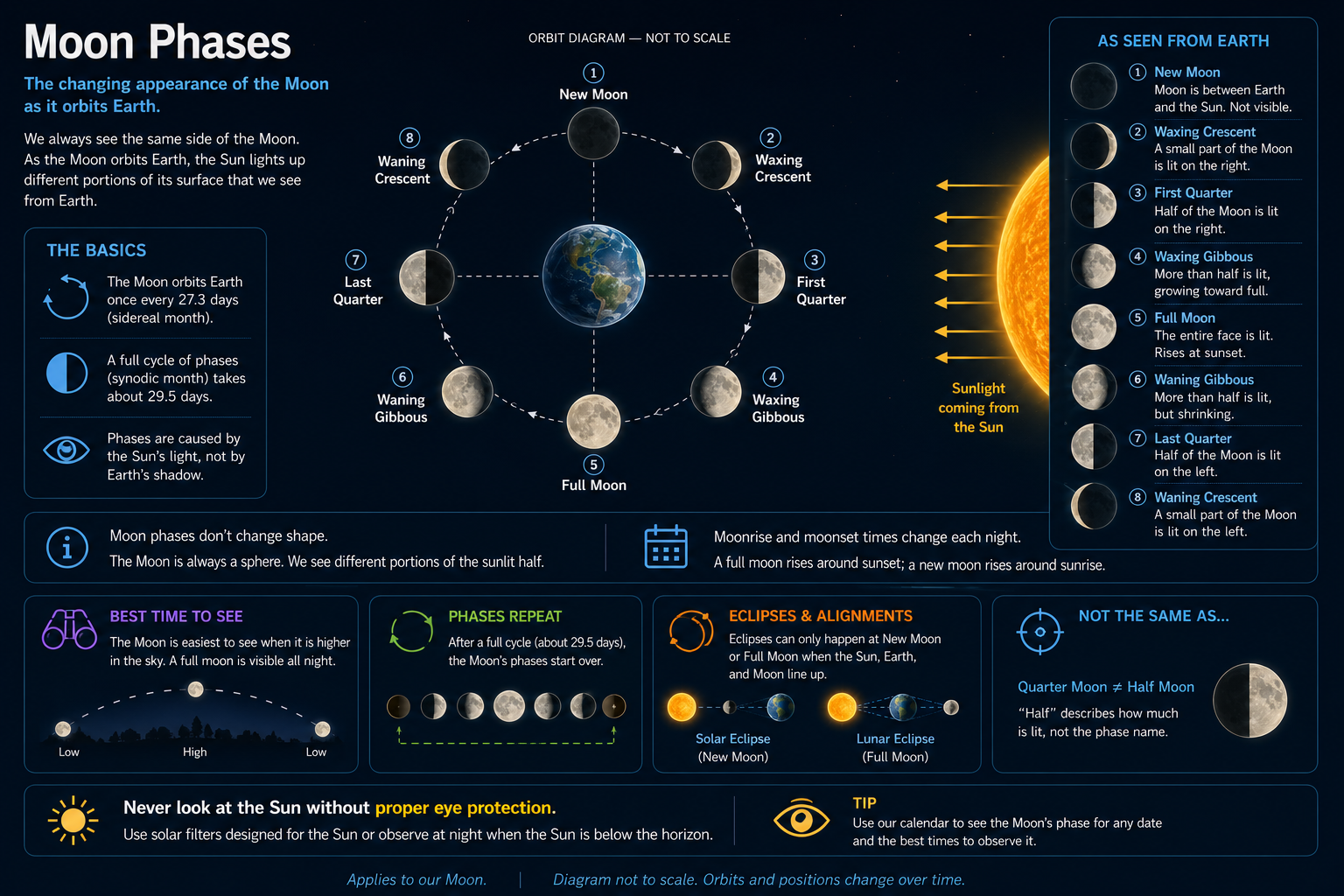
A Full Moon occurs when the Moon is opposite the Sun in Earth’s sky and its Earth-facing side is fully illuminated. The Moon rises near sunset, reaches its highest point around midnight, and sets near sunrise. This makes the Full Moon visible for most of the night, weather permitting.
What Is a Full Moon?
A Full Moon occurs when the Moon is opposite the Sun in Earth’s sky and its Earth-facing side is fully illuminated.
The Moon rises near sunset, reaches its highest point around midnight, and sets near sunrise.
This makes the Full Moon visible for most of the night, weather permitting.
Why the Full Moon Matters
The Full Moon is one of the easiest sky events to observe because it is bright, obvious, and visible without equipment.
Its brightness can transform the night landscape, but it also washes out faint stars, galaxies, nebulae, and the Milky Way.
For deep-sky observers and astrophotographers, Full Moon nights are usually better for lunar viewing than faint-object work.
What You Might See
The lunar disk appears round and fully illuminated.
Large dark plains called maria are easy to see, along with bright ray systems from young craters such as Tycho and Copernicus.
Because sunlight falls almost straight down on the lunar surface at Full Moon, crater shadows are less dramatic than during crescent or quarter phases.
How To Observe the Full Moon
The Full Moon is easy to see from cities, suburbs, and dark-sky locations.
For the most dramatic view, watch it rise near the eastern horizon around sunset.
The Moon often appears larger near the horizon due to the Moon illusion, although its actual angular size has not changed.
How to plan your observation
- Watch moonrise near sunset for the most scenic view.
- Use binoculars to see large maria and bright crater rays.
- Use a Moon filter or lower magnification if the view is too bright in a telescope.
- Avoid planning faint deep-sky observing during bright Full Moon nights.
- Try landscape photography when the Moon is low over the horizon.
The Science Behind the Full Moon
A Full Moon occurs because the Sun, Earth, and Moon are arranged with Earth roughly between the Sun and Moon.
The alignment is not usually perfect, which is why a lunar eclipse does not happen every month.
The Moon’s orbit is tilted relative to Earth’s orbit around the Sun, so most Full Moons pass above or below Earth’s shadow.
Fun Fact
Traditional Full Moon names, such as Harvest Moon or Wolf Moon, come from seasonal patterns, folklore, and cultural traditions.
The astronomical event is the same: the Moon is fully illuminated from Earth’s perspective.
What to remember
The Full Moon is beautiful, but it is not always the best time to view lunar surface detail.
Quarter and crescent phases often reveal more dramatic crater shadows along the terminator.
Common Questions About Full Moon
When does Full Moon occur?
Full Moon is listed for February 1, 2026.
Can I observe this event from my location?
Visibility depends on your location, local horizon, weather, and timing. Use Ephemeris with your saved observing location to check conditions.
What equipment should I use?
Naked eye, binoculars, telescope, or camera
